
-
 Analytical & Elemental Instruments
-
Biotechnology Lab Items
-
Cardboard and Box Factory Lab Equipment Solution
-
Cleanroom Solution
-
Consumables & Accessories
-
Dosing Pump for Chemicals
-
Electrochemistry & Titration
-
ETP -Effluent Treatment Plant
-
Feed Quality Laboratory
-
Food & Kitchen Lab Items
-
Hygiene Testing Equipment
-
Lab Furniture





Why Laboratory Balances & Weighing Equipment Are Critical for Modern Labs
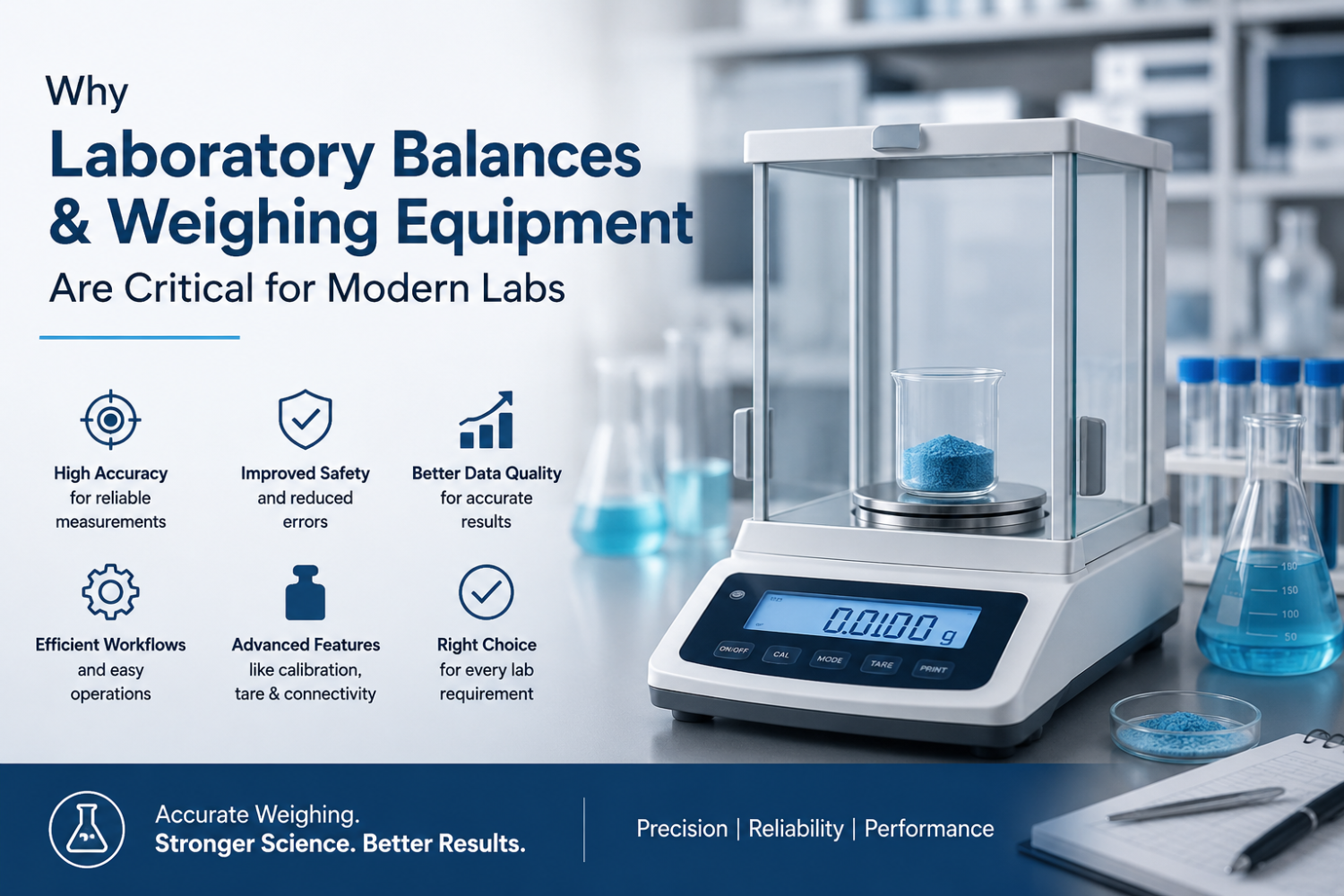
In modern laboratories, even a small weighing mistake can affect the whole process. That is why laboratory balances are such a vital part of today’s lab equipment. These instruments help you measure materials with the level of control needed for research, testing, formulation, and quality checks. Whether you work with tiny samples or larger batches, the right balance supports better decisions and more dependable outcomes. From pharmaceutical labs to educational labs and industrial spaces, weighing tools help teams stay organized, efficient, and accurate. Put simply, if your lab depends on exact numbers, your balance is not just another device on the bench. It is one of the main tools behind trustworthy work. The next sections explain why these balances matter so much.
Key Highlights
Laboratory balances are essential tools in modern laboratories because they support accurate measurements, stable workflows, and scientific accuracy in daily testing.
Precision balances are ideal for routine work with larger samples, while analytical models are built for smaller masses that need much finer control.
Reliable weighing improves quality control, sample preparation, and scientific research by reducing errors and helping teams get reliable results.
Features such as tare functions, calibration options, digital displays, and connectivity make today’s lab equipment easier to use and manage.
Environmental factors like air currents, vibration, and temperature changes can affect results, so proper setup and regular care matter.
Choosing the right balance depends on sample size, required precision, capacity, workflow needs, and the laboratory setting.
The Essential Role of Laboratory Balances in Modern Labs
A lab balance is considered essential because so much lab work starts with accurate weighing. If the weight is off, the next step can be off too. In scientific research, quality control, and routine testing, even a small error can change the final outcome. That makes laboratory balances some of the most important essential tools in the room.
You see this every day in modern lab workflows. Teams use precision weighing for sample preparation, chemical analysis, and formulation tasks that require consistency. A dependable balance also helps support repeatable work across users and batches. This is why modern labs rely on the right weighing equipment to protect both speed and accuracy. To understand that role better, it helps to look first at why weighing is the base of strong science.
Why Accurate Weighing is Foundational for Scientific Research
Scientific research depends on accurate measurements from the very start. When you weigh a reagent, sample, or standard, that number becomes part of every step that follows. If the initial value is wrong, the rest of the process can drift away from the truth. That is why measurement accuracy is not a small detail. It is the base of dependable lab work.
Reliable weighing equipment improves the accuracy of lab results by giving you stable, repeatable readings. A good balance helps reduce errors caused by poor sensitivity, weak setup, or inconsistent readings. In work such as chemical analysis, purity checks, gravimetric analysis, and drug formulation, precise measurements matter because the sample amount directly affects the result. Better weighing supports better comparisons, cleaner calculations, and stronger confidence in the outcome.
Just as important, strong weighing practice supports scientific accuracy across repeated tests. When your balance performs well and fits the task, you are more likely to produce consistent data over time. That helps in research settings, pharmaceutical applications, and environmental testing where trust in the result matters. In simple terms, reliable weighing equipment protects the quality of the science built on top of it.
How Laboratory Balances Drive Efficiency and Safety
Laboratory balances do more than show a number on a screen. In everyday laboratory testing, they support core tasks such as taring containers, weighing raw materials, checking sample amounts, and helping with formulation steps. These functions save time because staff can move from one step to the next without guesswork. Clear digital displays and simple controls also make modern lab equipment easier to use during busy laboratory operations.
Safety improves when weighing is done correctly. If you add too much or too little material, you may affect a reaction, a formulation, or a test condition. A proper balance helps you control the amount you use and supports more consistent results. This is especially helpful in pharmaceutical labs, food science work, and quality control environments where exact amounts matter every day.
A few common ways balances improve efficiency and safety include:
They speed up sample preparation with quick, easy tare and zero functions.
They help reduce handling mistakes by providing clear readings.
They support consistent results across repeated tests and multiple users.
They connect with systems for smoother recording and less manual entry.
When you combine accuracy with easier workflows, your team can work faster without losing control.
Impacts of Reliable Weighing on Laboratory Data Quality
Reliable weighing has a direct effect on data quality. Every weight reading becomes part of your records, calculations, or test conclusions. If the reading is unstable or inaccurate, the data collection process starts with a weakness. On the other hand, when the balance is dependable, the numbers going into your system are stronger from the beginning. That leads to more reliable data and clearer decisions.
Laboratory balances help enhance scientific accuracy and data reliability by improving repeatability and reducing variation between measurements. Features like calibration options, digital readouts, and connectivity support cleaner recordkeeping and smoother transfer of results. This matters in laboratory settings where teams need dependable values for quality control, research, and routine production checks. Better weighing also supports regulatory compliance because labs often need records that are traceable and consistent.
There is also a practical benefit. Reliable results save time and materials because staff do not need to repeat as many tests due to questionable readings. In pharmaceutical industry work, environmental science, and food industry testing, trusted data supports both performance and accountability. If your weighing process is stable, your reports, trends, and decisions become more dependable too.
Types of Laboratory Balances and Their Unique Functions
There are several different types of laboratory balances, and each one fits a specific job. The main options include microbalances, semi-micro balances, analytical balances, precision balances, and top-loading balances. They differ mostly in readability, capacity, and how sensitive they are to outside conditions. That means one model may be perfect for trace work, while another works better for routine weighing of larger samples.
In many laboratory settings, the biggest choice is often between an analytical balance and precision balances. Analytical models are built for very small masses and much finer readings. Precision models are better for general work where you need solid accuracy and higher capacity. Microbalances go even further for ultra-trace tasks, while top-loading units are useful for bulk weighing. Next, we will compare the most common balance choices in a simple way.
Analytical Balances vs Precision Balances
Choosing between an analytical balance and precision balances depends on what your laboratory operations require. If you work with very small sample size amounts and need extremely fine accurate weighing, an analytical balance is usually the better choice. It is designed for small masses and uses highly sensitive technology inside an enclosed chamber. If your work is more routine and involves larger samples, a precision model is often the more practical option.
The biggest differences are readability, capacity, and environmental sensitivity. Analytical units often read to 0.0001 g or finer, but they usually handle smaller loads. Precision balances commonly read from 0.001 g to 0.01 g and can support much higher capacity. They are also more robust in typical lab spaces. So, when should you choose one over the other? Use analytical models for trace-level work such as sensitive chemical analysis. Use precision models for sample preparation, quality control, and general weighing.
Feature | Analytical Balance | Precision Balances |
|---|---|---|
Typical readability | 0.0001 g or finer | 0.001 g to 0.01 g |
Capacity | Usually up to about 320 g | Several hundred grams to many kilograms |
Draft shield | Always included | Sometimes included |
Best for | Trace work, purity analysis, pharma research | Routine weighing, QC, education, general lab use |
Environmental sensitivity | High | Moderate |
Sample size fit | Small masses | Larger samples |
Microbalances and Specialized Equipment
Some labs need even more sensitivity than a standard analytical unit can provide. That is where microbalances and other specialized tools come in. Microbalances are sensitive devices made for ultra-trace work and very small masses. They can measure down to microgram levels and are used when tiny changes in weight matter a great deal. Because of that, they are suited to advanced research and high-precision applications.
Specialized weighing equipment can also include tools such as moisture analyzers. These are helpful when the goal is not just total weight, but moisture content as well. In certain workflows, that type of result is more useful than a simple mass reading. Different devices serve different needs, so the best choice depends on the job you need done in the lab.
Analytical balances sit between broad routine use and ultra-trace weighing. Their advantages include excellent sensitivity, strong support for accurate work, and a draft shield that protects against air movement and static. Their disadvantages are also clear. They cost more, they are more sensitive to environmental changes, and they require a stable setting. In short, analytical balances are powerful, but they work best when your process truly needs that level of control.
Choosing the Right Balance for Your Lab’s Needs
Picking the right laboratory balance starts with a simple question: what do you need it to do every day? Some labs need very fine measurements for small samples. Others need fast, reliable weighing for sample preparation and routine checks. A lab balance should match your real workflow, not just look impressive on paper. The wrong model can slow your team down or give you more sensitivity than you actually need.
Several factors matter when selecting weighing equipment for your laboratory. Accuracy is one part of the decision, but not the only part. Sample size, daily workload, budget, and where the unit will be used all affect performance. Environmental factors are especially important with highly sensitive models. Operational factors such as cleaning, connectivity, and calibration needs also shape long-term value.
When comparing options, focus on these points:
The sample preparation tasks and typical sample size you handle
The readability and capacity your work actually requires
The environmental factors in your weighing area, such as drafts or vibration
The operational factors that affect daily use, like maintenance and data transfer
A good fit makes weighing easier, faster, and more dependable for your team.
Key Features to Consider When Selecting Laboratory Weighing Equipment
When you compare laboratory balances, it helps to look past the brand name and focus on the key features that affect daily work. In everyday laboratory testing, weighing balances serve practical functions such as zeroing containers, measuring samples, supporting formulation steps, and helping staff record results clearly. That means the right model should be easy to read, easy to clean, and well matched to your usual tasks.
At the same time, advanced features can improve how your lab equipment fits into the rest of your workflow. Internal or external calibration, digital displays, application modes, and system connectivity all add value when used correctly. Some labs also benefit from data logging and links to software tools. The next sections break these features down so you can judge what matters most for your work.
Sensitivity, Capacity, and Readability Explained
Three terms matter a lot when you choose a weighing scale: sensitivity, capacity, and readability. Sensitivity refers to how small a change the instrument can detect. Capacity is the maximum load it can handle. Readability is the smallest difference the display can show. These points may sound technical, but they affect your daily work in a very practical way.
If you use a balance with the wrong capacity, you may overload it or limit what you can weigh. If the readability is too low, you may miss the small changes that matter in your method. A balance with the right combination helps you get accurate measurements without making the process harder than it needs to be. The weighing pan also matters because its size affects what containers and samples can be placed on it safely and easily.
Correct use of lab balances can change the outcome of scientific experiments because the first number in the process often shapes every step after it. Better matching between the instrument and the task supports cleaner sample preparation, stronger repeatability, and more trustworthy results. So when you review specs, do not treat them as minor details. They define whether the balance fits your experiment well or poorly.
Advanced Features and Digital Innovations
Modern digital balances often include advanced features that make weighing easier and more organized. Common examples include digital displays, tare and zero functions, internal or external calibration options, and built-in application modes such as parts counting, formulation, percentage weighing, and density work. These tools help users move through tasks with less manual effort and fewer simple mistakes.
Another major benefit is connectivity. Many models support USB or RS232 links, which allow results to move to computers, printers, or lab management systems. That supports data logging and cuts down on hand-written entries. In labs where records matter, that can improve speed and reduce transcription problems. Some units also offer touchscreens or compliance-focused interfaces for more structured use.
Used correctly, these features can improve experiment outcomes because they support cleaner workflows and more dependable records. You are not just reading a number. You are also controlling how that number is captured, stored, and used in later steps. For labs that value traceability and consistency, digital innovations can make a clear difference without making operation harder.
Environmental and Operational Factors Impacting Performance
One of the most common challenges with laboratory weighing equipment is that the surrounding space can affect the result. Environmental factors such as air currents, vibration, direct sunlight, static, and temperature changes can all disturb sensitive measurements. This is especially true for highly precise instruments. Even when the balance itself is working well, poor environmental conditions can make the reading unstable.
The good news is that many of these problems can be avoided with simple controls. A stable bench, a level setup, and a draft-free area make a big difference. Analytical models benefit from a draft shield and a more controlled setting, while less sensitive units are usually more tolerant. Regular maintenance and calibration checks also help prevent drift and keep performance on track over time.
To reduce common weighing problems, focus on these steps:
Keep the balance away from air currents, vibration, and sudden temperature changes
Place it on a stable, level surface and use controlled environmental conditions when possible
Follow regular maintenance and calibration routines to protect long-term accuracy
Small setup changes often lead to much better stability and more reliable readings.
Conclusion
In summary, laboratory balances and weighing equipment are indispensable tools that form the backbone of modern scientific research. Their role goes beyond mere measurement; they ensure accuracy, enhance safety, and improve data quality, which is vital for sound scientific conclusions. By understanding the various types of balances and their specific functions, labs can make informed decisions tailored to their unique needs. Choosing the right equipment and considering key features will not only optimize performance but also elevate the overall efficiency of laboratory operations. If you’re ready to enhance your lab’s capabilities, don’t hesitate to reach out for a free consultation to see how we can assist you in selecting the perfect weighing solutions!
Frequently Asked Questions
What are the main advantages of using analytical balances in a laboratory?
An analytical balance offers much finer sensitivity than many precision balances, which makes it ideal for accurate measurements of small samples in laboratory settings. Its draft shield and high-resolution design help protect readings from outside disturbance. This makes it useful for trace work, chemical analysis, and pharmaceutical tasks where even tiny differences matter. It can also support stronger record quality and regulatory compliance when exact values are required. The tradeoff is that it costs more and needs tighter environmental control.
How can labs in Bangladesh ensure optimal accuracy with weighing equipment?
Labs in Bangladesh can improve accurate weighing by matching their lab equipment to the work being done and controlling environmental factors around the balance. Laboratory balances should be placed on stable, level surfaces away from drafts, vibration, and direct heat. Regular calibration is also essential, especially for highly sensitive models. Staff should keep the weighing area clean and use the balance within its rated capacity and readability range. These simple steps help protect consistency and reduce avoidable measurement errors.
What are common challenges faced when using laboratory balances and how can they be managed?
Common challenges with laboratory balances include environmental changes, unstable placement, poor calibration habits, and buildup of dust or residue. These issues can cause drifting readings, slow stabilization, or inconsistent output. You can manage them by placing lab equipment on a solid, level bench, protecting sensitive units from drafts and vibration, and following regular maintenance routines. Scheduled calibration checks and careful cleaning also help. When these basics are handled well, the balance is more likely to deliver reliable results day after day.
Recent Posts

The Role of Laboratory Safety & Environmental Monitoring in Risk Prevention

Health and Hygiene Ware Material Testing: Ensuring Quality, Safety, and Compliance
Advancements in Sample Preparation Equipment for R&D and Quality Control

Essential Biotechnology Lab Items and Their Applications in Modern Research



Understanding ETP – Effluent Treatment Plant and Its Importance in Industry

Why a Reliable Cleanroom Solution is Critical for Laboratory and Production Safety?

The Role of Electrochemistry & Titration in Modern Analytical Chemistry
Optimum Solution– Laboratory & Analytical Instruments Supplier in Bangladesh
Optimum Solution is a leading supplier of laboratory equipment, analytical instruments, and process control solutions in Bangladesh. Since our inception, we have built a strong presence in the industry, serving research labs, universities, pharmaceutical companies, and quality control laboratories nationwide. Through continuous dedication to improving our products and services, Optimum Solution has earned the trust and loyalty of our valued clients.


