
-
 Analytical & Elemental Instruments
-
Biotechnology Lab Items
-
Cardboard and Box Factory Lab Equipment Solution
-
Cleanroom Solution
-
Consumables & Accessories
-
Dosing Pump for Chemicals
-
Electrochemistry & Titration
-
ETP -Effluent Treatment Plant
-
Feed Quality Laboratory
-
Food & Kitchen Lab Items
-
Hygiene Testing Equipment
-
Lab Furniture





The Role of Electrochemistry & Titration in Modern Analytical Chemistry
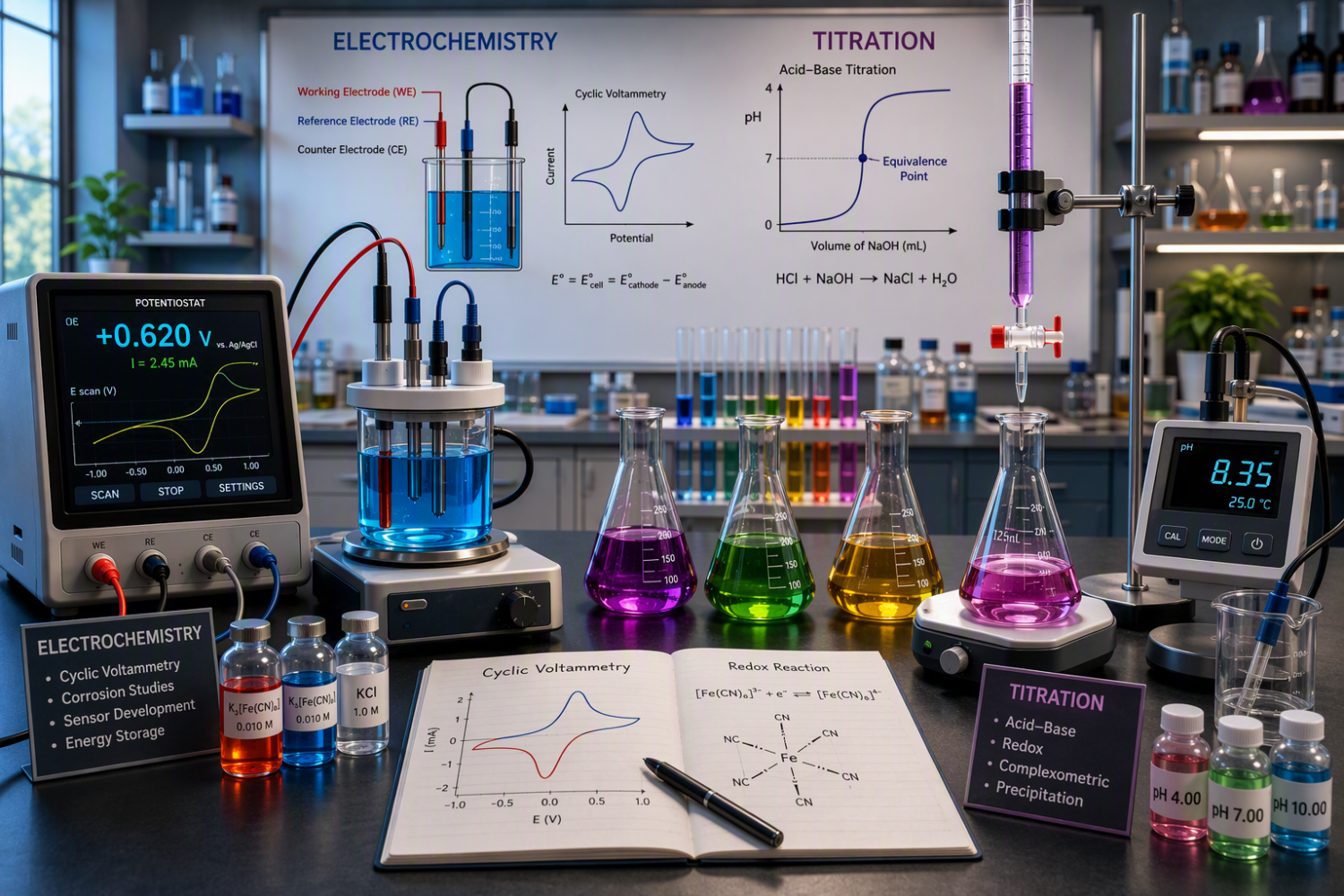
Modern analytical chemistry depends on methods that can measure substances clearly and reliably. Two of the most useful are titration and electrochemistry. Titration helps you find the concentration of an unknown sample by reacting it with a standard solution. Electrochemistry studies chemical change through electron movement and electrical behavior. Together, these approaches support accurate testing in laboratories, industry, and environmental work. To see why they matter so much, it helps to start with the foundations of measurement and chemical analysis.
Key Highlights
Titration is a core tool in analytical chemistry for quantitative analysis of an unknown sample.
The stoichiometry of the reaction links the volume added to the amount being measured.
Common types of titrations include base titration, acid-base work, and redox titrations.
Electrochemistry tracks reactions in real time through electron-based signals.
These methods support practical applications in laboratories, industry, water checks, and product testing.
Foundations of Analytical Chemistry
At its core, analytical chemistry is about understanding what a sample contains and how much of it is present. That makes chemical analysis useful in both research and routine testing. It supports quantitative analysis, where exact amounts matter.
In practice, this field uses different analytical tools, including types of titrations and electrochemical methods. These are important in industrial processes, where speed and reliable numbers shape decisions. The next sections explain the key ideas that make these methods work.
Key Concepts in Analytical Chemistry
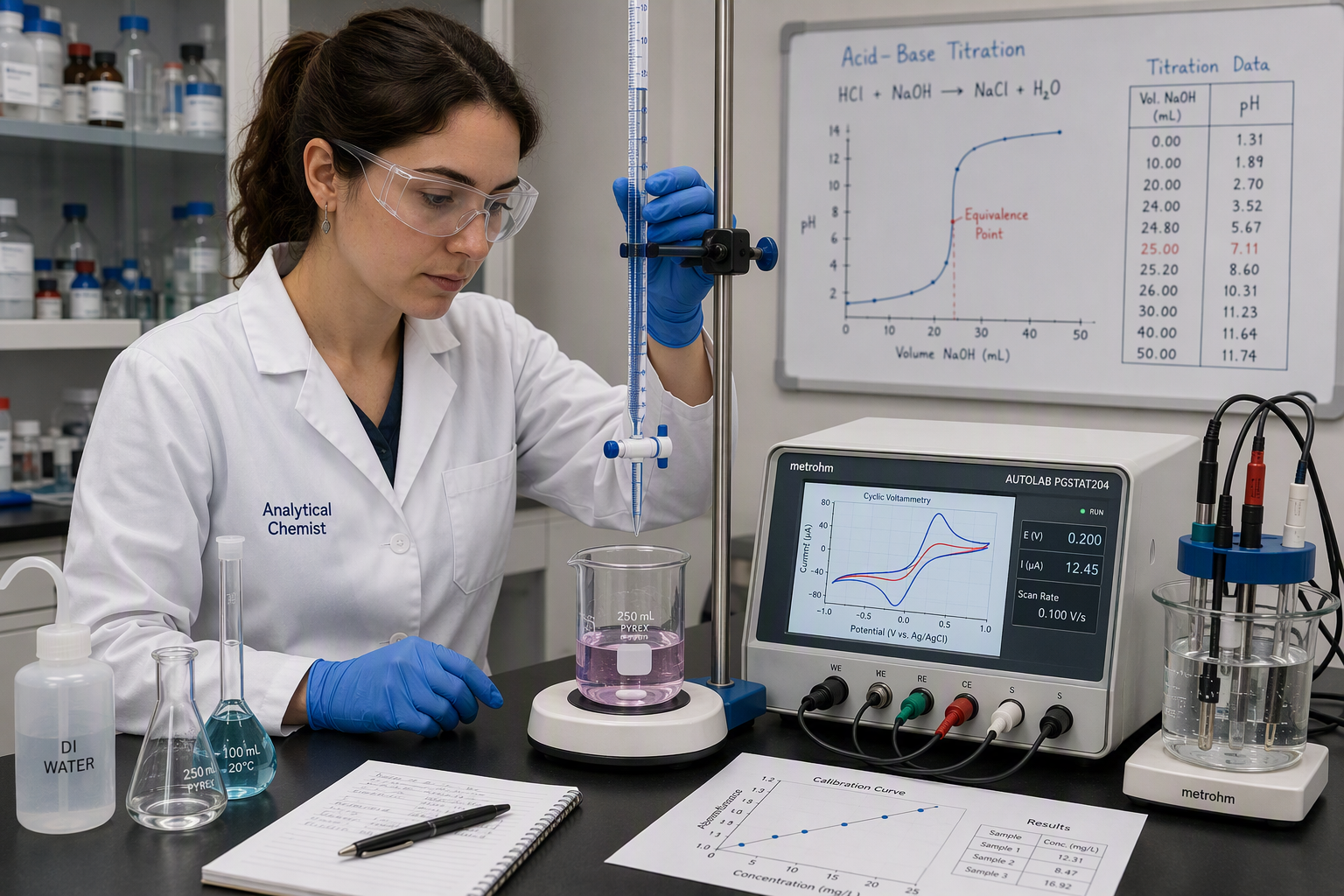
Every analytical method starts with a simple goal: measure a substance in a dependable way. In wet chemistry, that often means causing a controlled chemical reaction and observing how a sample solution responds. If the reaction is known and complete, the result can be translated into concentration or purity.
Another key idea is selectivity. You want the method to respond to the target material, not to unrelated components. That is why chemists may dilute a sample, control pH, or use masking solutions. These steps reduce interference and improve the final reading.
The value of these concepts shows up in practical applications. Laboratories use them to test water, medicines, food materials, and process streams. In industrial processes, strong analytical control helps maintain consistency, safety, and product quality from batch to batch.
Importance of Accuracy and Precision in Analysis
When you measure chemicals, close is not always good enough. Quantitative analysis depends on getting a dependable value for the amount of analyte in a sample. In titration, small mistakes in the volume of titrant can change the final answer.
Precision also matters because the endpoint of the titration may come within a drop. If that point is missed, the calculated concentration can shift. That is why good technique and clear endpoint detection are central to reliable work.
A measured sample volume helps control the amount of analyte from the start.
Careful reading of the volume of titrant reduces calculation error.
A sharp endpoint of the titration improves confidence in the result.
Repeating the test checks whether the quantitative analysis is consistent.
Introduction to Electrochemistry
Electrochemistry looks at chemical change through electrical behavior. In many reactions, substances gain or lose electrons, and that electron transfer can be measured. This makes electrochemistry a useful branch of analytical chemistry.
It is especially helpful when you need sensitive detection of reactive species or quick monitoring during a reaction. Instead of waiting only for a visible change, you can track electrical signals. That gives electrochemical methods an important place in modern laboratory analysis.
Basic Principles of Electrochemical Reactions
Electrochemical reactions are built on the transfer of electrons. One substance loses electrons and acts as a reducing agent. Another gains electrons and acts as an oxidizing agent. This exchange is the basis of many analytical measurements.
Because the reaction involves charged species, electrical signals can reveal what is happening in the solution. A change in potential or current can show that the reaction is moving forward, slowing down, or nearing completion. That gives chemists a direct way to monitor chemical behavior.
The reaction rate can also matter. Some systems respond quickly, while others need controlled conditions or heating to move at a practical speed. In analytical work, understanding the oxidizing agent, reducing agent, and electron path helps you choose the right method and detect the endpoint more clearly.
Common Electrochemical Techniques in Laboratories
Electrochemical testing gives laboratories another way to study samples beyond visible color shifts. Since electron transfer creates measurable signals, this analytical method can be used to follow reactions with good sensitivity. It is especially useful when a standard indicator is not ideal.
Several tools are used to watch reactions in real time. Some methods measure potential, some focus on current, and others track conductivity. These approaches can support different types of titrations and other wet chemistry procedures.
Potentiometric methods measure electrode potential as a reaction proceeds.
pH meters help monitor acid-base systems during titration.
Conductivity measurements follow changes in ions in solution.
Amperometric approaches detect current from oxidation or reduction.
These techniques can confirm endpoints in real time.
Overview of Titration Methods
A titration method measures the concentration of a substance by reacting it with a known solution. In the titration process, the added reagent is delivered in small, controlled amounts until the reaction reaches a detectable ending point.
You will find several types of titrations in analytical chemistry, each matched to a certain type of reaction. A base titration, for example, is used in acid-base work, while redox and complex-based methods serve other needs. Understanding the basics makes the later details much easier.
Definition and Core Principles of Titration
Titration is a laboratory technique used to find the concentration of the analyte in a sample. The idea is simple: you react the unknown with a standard solution whose concentration is already known. By measuring how much of that solution is required, you can calculate the unknown value.
The method depends on a known chemical relationship between the two reacting substances. If the reaction is complete and the ratio is clear, the amount added tells you how much analyte was present. That is why balanced reactions and careful preparation matter.
A successful titration also needs a clear endpoint of the titration. This may be shown by a color shift, a pH jump, or an electrical reading. Once the endpoint is reached, the concentration of the analyte can be determined with confidence.
Steps Involved in Titration Procedures
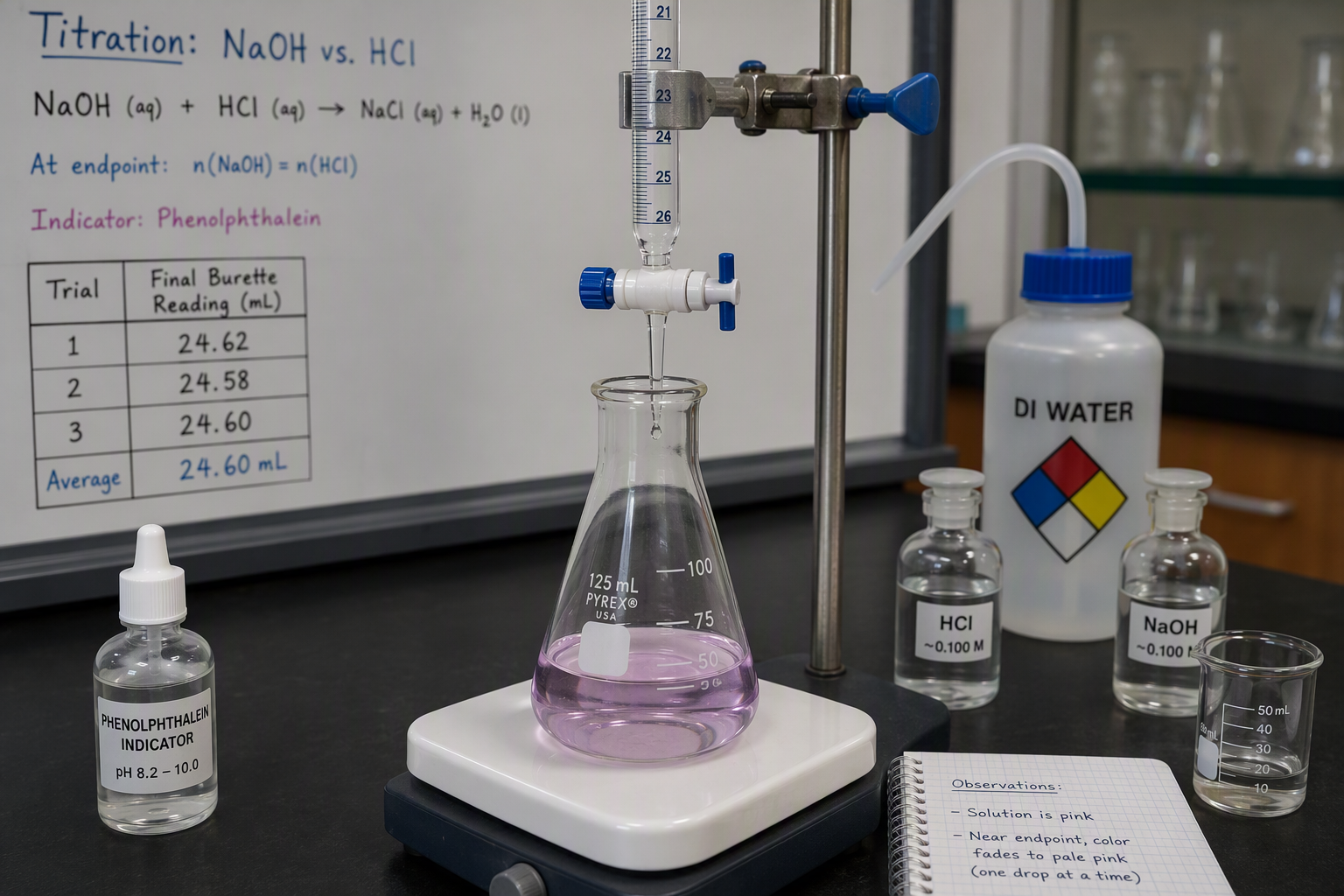
The titration process begins with preparing both the unknown sample and the known reagent. A measured portion of the sample is placed in an erlenmeyer flask, often with an indicator. The titrant is loaded into a burette or similar device.
Next, the titrant is added slowly while the flask is stirred. As the reaction proceeds, you watch for a color change or another sign that the reaction is nearly complete. Care is needed because even a small extra addition can pass the endpoint of the titration.
Measure the sample into an erlenmeyer flask.
Add a suitable indicator if the method needs one.
Deliver the titrant slowly and record the volume of titrant.
Stop when the endpoint of the titration gives a lasting color change.
Types of Titrations in Analytical Chemistry
The main types of titrations are grouped by the kind of reaction involved. In analytical chemistry, the best-known examples are acid-base titration, complexometric titration, precipitation methods, and redox titrations. Each one targets a different chemical behavior.
This classification matters because the indicator, equipment, and calculation approach can change from one method to another. Once you know the reaction type, it becomes easier to choose the right technique for the sample and the result you need.
Acid-Base Titration Techniques
Acid-base titration is built on neutralization between an acid and a base. In a base titration, a standard base reacts with an acidic sample, or the reverse setup may be used depending on which concentration is unknown. The key is a complete and known reaction.
Choosing the indicator depends on the expected pH range near equivalence. For weak acids with strong bases, one indicator may work best, while a different one is better for weak bases with strong acids. Methyl orange is commonly used when the endpoint falls on the acidic side.
A titration curve helps explain these choices. It shows how pH changes as titrant is added. Strong acid and strong base systems often give a steep change, while weak acids or weak base systems can produce a more irregular curve, making endpoint selection more important.
Complexometric and Precipitation Titrations
Not all titrations are based on acid and base behavior. In a complexometric titration, the titrant forms a stable complex with the analyte. This approach is widely used for metal ions in solution, especially when direct acid-base methods would not be useful.
EDTA is a well-known reagent for this kind of work because it binds certain metal ions effectively. The endpoint of the titration is usually shown with a special indicator that changes when the metal is fully complexed. That gives a practical way to measure hardness-related ions and similar targets.
Precipitation titrations work differently. Here, the reaction forms an insoluble solid. Since cloudiness can make the endpoint harder to judge, chemists may use a back titration. As with any accurate method, careful preparation of the standard solution from a primary standard improves reliability.
Redox Titrations and Their Analytical Significance
Redox titrations are based on redox reactions, where electrons move between substances. One acts as a reducing agent and the other as an oxidizing agent. That makes these methods especially useful for substances that can be oxidized or reduced in solution.
In analytical chemistry, redox titrations are important because they support clear quantitative work in many laboratory settings. They can use indicators, instruments, or even the color of the reacting chemicals themselves. That flexibility explains their broad use.
Understanding Redox Reactions in Titration
In redox reactions, the central event is the transfer of electrons. The reducing agent donates electrons, while the oxidizing agent accepts them. During titration, this exchange happens in a controlled way so the unknown amount of one reactant can be measured.
What makes this useful is that many redox systems show a visible or measurable change near completion. Some need a redox indicator, while others have their own built-in signal. Potassium permanganate, for example, can show the endpoint through a faint lasting pink color.
This type of titration is practical because the chemistry is direct and strongly tied to quantity. Once the transfer of electrons is accounted for, the amount of analyte can be calculated from the titrant volume. That is why redox titrations remain a trusted tool in routine analysis.
Applications of Redox Titration in Laboratory Practice
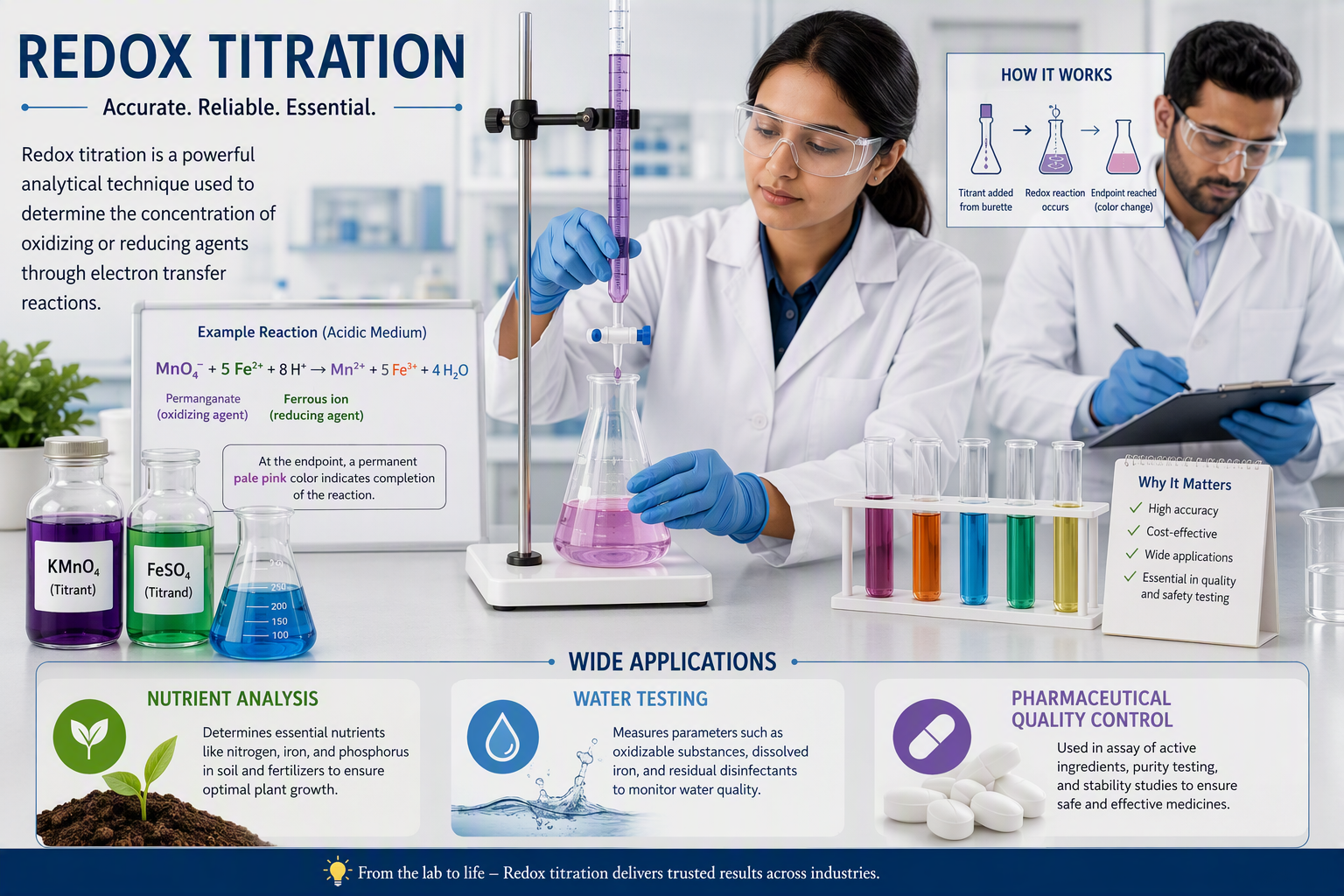
Redox titrations have many practical applications because oxidation and reduction are common in real samples. They are used when you need to measure compounds that react cleanly with an oxidizing or reducing reagent. This makes them useful in both teaching labs and specialized testing.
You can see their value across several settings. They support checks on nutrients, dissolved oxygen, and chemical quality. In some cases, the analyte or titrant gives its own visible signal, which simplifies the procedure.
Vitamin c can be measured because it acts as a reducing agent.
Water samples can be tested for dissolved oxygen by redox methods.
Iodine-based systems are used in routine laboratory analysis.
The pharmaceutical industry uses redox chemistry in quality-focused testing.
These practical applications show why redox titrations remain widely used.
Electrochemical Titrations Explained
Electrochemical titrations combine titration with electrical measurement. Instead of relying only on an indicator, they follow changes linked to electron transfer, potential, current, or conductivity as the reaction moves forward. That can make endpoint detection clearer.
These methods are useful when color-based detection is weak or when side reactions make visual judgment harder. By following the electrical response, you can identify the endpoint of the reaction more directly. That gives electrochemical titrations a practical edge in many analyses.
How Electrochemical Titrations Are Performed
The basic setup is similar to a standard titration process. A measured sample solution is placed in an erlenmeyer flask or other reaction vessel, and a titrant of known concentration is added carefully. The difference is that electrodes or a meter are used to monitor the reaction.
As the titrant enters the sample solution, the instrument records changes in potential, pH, current, or conductivity. These changes reflect what is happening chemically in the flask. Near completion, the signal usually shifts in a clear way that marks the endpoint.
Electrochemical titrations are especially useful when the sample is colored, cloudy, or hard to judge by eye. Since the reading comes from the instrument rather than only from a dye, the method can provide a sharper and more objective finish to the analysis.
Advantages and Limitations of Electrochemical Titrations
Electrochemical titrations stand out because they can track reaction progress through measured signals. This helps when visual indicators are weak or when the solution has its own strong color. In some cases, they can measure lower concentrations more effectively than simpler visual methods.
Still, no method is perfect. The result can be affected by instrument setup, interfering ions, or unexpected side reactions. That is why method choice depends on the sample, the required sensitivity, and the kind of endpoint you need.
They can monitor reactions in real time.
They may work well at lower concentrations.
They help estimate the concentration of the analyte without relying only on color.
Some side reactions or matrix effects can complicate the signal.
Compared with other types of titrations, they often need more equipment.
Essential Equipment for Electrochemistry & Titration
Good results depend on the right setup. In titration and electrochemistry, common laboratory tools include burettes, pipettes, electrodes, and the erlenmeyer flask. Each piece has a clear job, from measuring liquid volume to detecting electrical change.
When these tools are clean, calibrated, and used correctly, your analysis becomes more reliable. Some are simple glassware, while others are measuring devices. The next section breaks down their roles in a text table so you can see how they fit into the workflow.
Electrodes, Burettes, and Other Key Laboratory Tools
Laboratory work in this area depends on both measuring and sensing. Burettes and pipettes handle accurate liquid delivery, while electrodes and meters help detect chemical change. The erlenmeyer flask supports mixing during the reaction without excessive splashing.
Each item helps reduce error in a different way. Some improve volume control, while others improve endpoint detection. Used together, these laboratory tools create a reliable system for routine chemical analysis.
Tool | Main use |
|---|---|
Burettes | Deliver the titrant in controlled, measured amounts |
Pipettes | Transfer a precise sample or reagent volume |
Erlenmeyer flask | Hold and mix the reacting solution during titration |
Electrodes | Detect pH, potential, or related electrochemical change |
pH meter or potentiometer | Measure signal changes that help locate the endpoint |
Choosing the Right Indicator for Accurate Results
An indicator works by showing a visible color change near the endpoint. The key is to match the indicator to the expected pH range or reaction behavior. If the indicator shifts too early or too late, your result can drift away from the true equivalence point.
This is why indicator choice depends on the chemistry of the system. Strong acid and strong base reactions may allow several options, while weak acids or weak base systems need more care. In some difficult cases, a meter replaces the indicator entirely.
Methyl orange is useful when the endpoint falls in an acidic pH range.
Phenolphthalein fits basic endpoint regions better.
Indicators show different colors on either side of their transition.
A sharp, lasting color change helps reduce endpoint error.
Real-World Applications of Electrochemistry & Titration
These methods matter because they solve real testing problems. Titration and electrochemistry support various applications across environmental science, manufacturing, health-related analysis, and product evaluation. They turn reaction data into practical decisions.
You can see their value in pharmaceutical quality control, food industry testing, and water assessment. In each case, the goal is the same: measure chemical properties clearly enough to support safe, consistent outcomes. The following sections look at those uses more closely.
Industrial Uses in Pharmaceuticals and Food Analysis
In industry, measurements must be clear and repeatable. The pharmaceutical industry depends on chemical testing to confirm that materials and finished products meet expected standards. Titration helps determine the concentration of an analyte in a dependable, structured way.
Food analysis also uses these methods because food products can vary in acidity, composition, and quality. A simple volumetric method can help track whether a batch stays within set limits. That supports quality control without requiring overly complex equipment for every task.
The pharmaceutical industry uses titration in routine quality control.
Food products can be checked for composition-related chemical values.
Analysts use measured reactions to find the concentration of an analyte.
Standardized testing helps compare one batch with another.
Environmental and Clinical Analytical Applications
Outside manufacturing, these methods play a strong role in public and environmental work. Environmental monitoring often depends on testing water and other samples for key chemical properties. Reliable numbers support action when quality changes.
Water samples are a common example. Redox methods can be used to determine dissolved oxygen, and other titration procedures can support broader chemical checks. These measurements matter for environmental protection because they help identify changes before they become bigger problems.
Environmental monitoring uses routine chemical measurements to track change.
Water samples can be tested for oxygen and other important properties.
Environmental protection benefits from early, reliable analysis.
Clinical testing also uses measured chemical procedures in selected cases.
Conclusion
The interplay of electrochemistry and titration plays a vital role in modern analytical chemistry. By understanding the foundational principles and employing various titration methods, chemists can achieve remarkable accuracy and efficiency in their analyses. Whether working in pharmaceuticals, food analysis, or environmental testing, the knowledge of these techniques empowers professionals to solve complex problems and enhance the quality of their results. Embracing these methods not only fosters a deeper appreciation for the science but also drives innovation across multiple industries. If you're eager to delve deeper into how these techniques can revolutionize your analytical practices, don’t hesitate to get in touch for a free consultation!
Frequently Asked Questions
Why is titration considered a quantitative analytical technique?
Titration is used for quantitative analysis because it measures how much standard solution is needed to react with a sample. Once the endpoint of the titration is reached, that measured volume is used to calculate the concentration of the analyte from the known reaction ratio.
How does electroanalytical chemistry differ from other analytical methods?
Electrochemistry differs because the analytical method tracks electrical behavior linked to electron transfer. Instead of relying only on visible changes, it can monitor potential, current, or conductivity in real time. That makes it useful for following reaction rate changes and detecting endpoints more objectively.
What are the main advantages of using electrochemistry as an analytical tool?
Electrochemistry helps analytical chemistry by giving sensitive, instrument-based readings during reactions. It supports practical applications, works well with several types of titrations, and can be useful at lower concentrations where visual indicators are weak. It also helps when samples are colored or difficult to judge by eye.
What Makes Electrochemical Titrations Unique?
What makes electrochemical titrations unique is their ability to detect chemical change through electron transfer rather than color alone. In analytical chemistry, this can help with lower concentrations and difficult samples. Their practical applications are strongest where visual endpoints are weak or unreliable.
How does electroanalytical chemistry compare to other approaches?
Electroanalytical chemistry stands out due to its sensitivity and selectivity, allowing for the detection of trace amounts of substances. Compared to techniques like chromatography and spectroscopy, it offers rapid analysis and real-time data, making it particularly valuable in various fields including environmental monitoring and pharmaceuticals.
Why is titration important for quantitative analysis?
Titration is crucial for quantitative analysis as it allows precise measurement of substance concentrations, ensuring accurate results in various applications. This technique helps determine the endpoint of reactions, making it indispensable in fields like pharmaceuticals, environmental testing, and food chemistry for quality control.
What are the practical benefits of electrochemistry as an analytical tool?
Electrochemistry offers practical benefits such as high sensitivity, rapid analysis, and the ability to measure concentrations of ionic species in complex mixtures. Its versatility across various applications, including environmental monitoring and pharmaceuticals, makes it an invaluable tool in modern analytical chemistry.
Why is titration preferred for quantitative analysis?
Titration is preferred for quantitative analysis due to its precision and accuracy in determining the concentration of unknown solutions. It allows for clear endpoint detection, is cost-effective, and can be easily standardized, making it a reliable method in various analytical applications.
What sets electroanalytical chemistry apart from other methods?
Electroanalytical chemistry distinguishes itself through its reliance on electrical signals to analyze chemical properties. This method allows for highly sensitive detection and real-time analysis, making it invaluable in various applications compared to traditional methods, which often require more extensive sample preparation and longer processing times.
What are key advantages of electrochemistry in the laboratory?
Electrochemistry offers precise measurement capabilities, rapid analysis, and the ability to work with small sample volumes. Its versatility allows for various applications, including battery testing and sensor development, making it essential for modern analytical chemistry in the laboratory setting.
Recent Posts

The Role of Laboratory Safety & Environmental Monitoring in Risk Prevention

Health and Hygiene Ware Material Testing: Ensuring Quality, Safety, and Compliance
Advancements in Sample Preparation Equipment for R&D and Quality Control

Essential Biotechnology Lab Items and Their Applications in Modern Research



Understanding ETP – Effluent Treatment Plant and Its Importance in Industry

Why a Reliable Cleanroom Solution is Critical for Laboratory and Production Safety?
The Role of Electrochemistry & Titration in Modern Analytical Chemistry
Optimum Solution– Laboratory & Analytical Instruments Supplier in Bangladesh
Optimum Solution is a leading supplier of laboratory equipment, analytical instruments, and process control solutions in Bangladesh. Since our inception, we have built a strong presence in the industry, serving research labs, universities, pharmaceutical companies, and quality control laboratories nationwide. Through continuous dedication to improving our products and services, Optimum Solution has earned the trust and loyalty of our valued clients.


