
-
 Analytical & Elemental Instruments
-
Biotechnology Lab Items
-
Cardboard and Box Factory Lab Equipment Solution
-
Cleanroom Solution
-
Consumables & Accessories
-
Dosing Pump for Chemicals
-
Electrochemistry & Titration
-
ETP -Effluent Treatment Plant
-
Feed Quality Laboratory
-
Food & Kitchen Lab Items
-
Hygiene Testing Equipment
-
Lab Furniture





Food Laboratories in Bangladesh: Role of BSTI, Required Instruments & Industry Growth | Optimum Solution
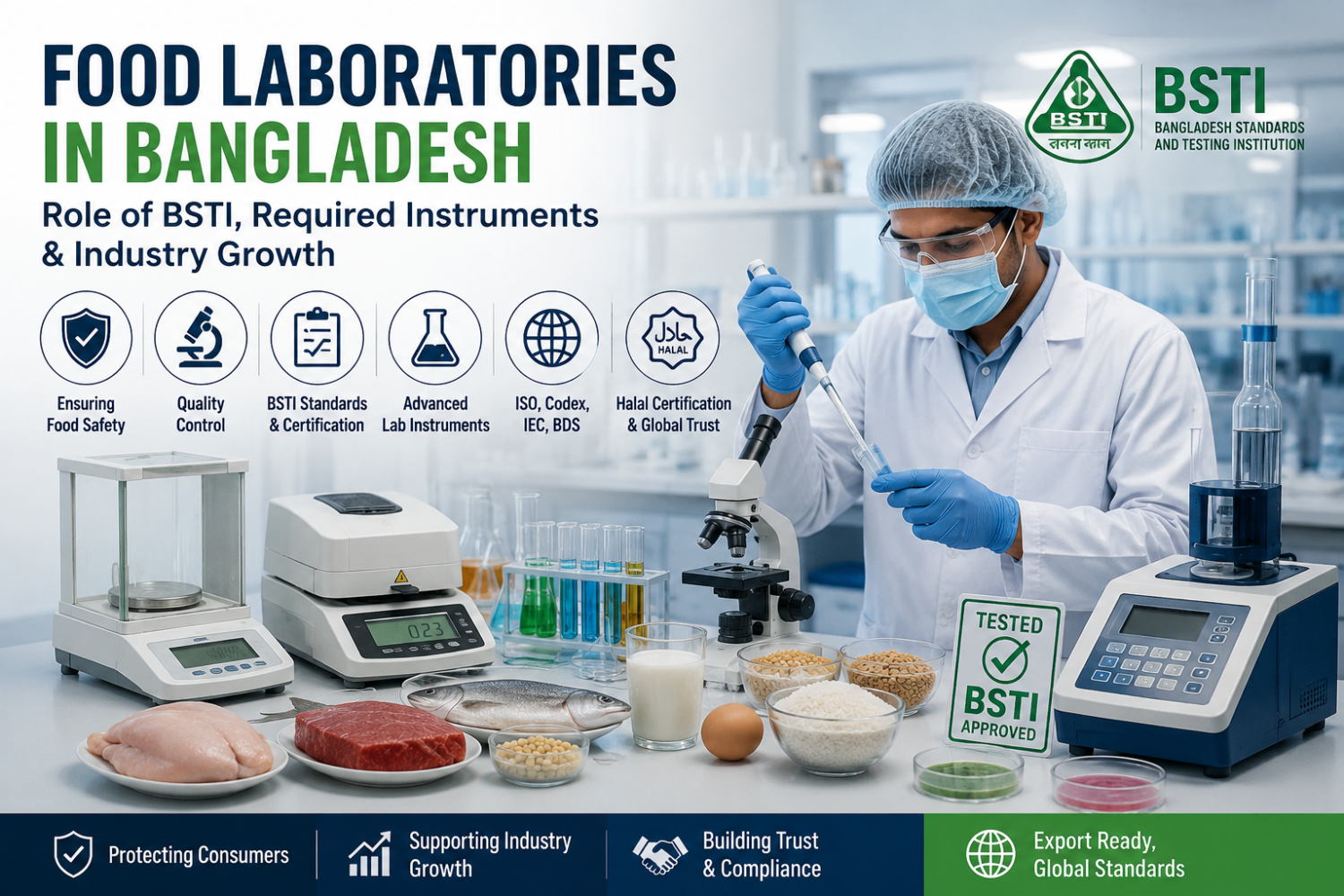
Food testing matters because it helps protect people, support honest business, and improve quality control across the supply chain. In Bangladesh, this work is closely tied to national standards set by BSTI, the country’s main standards and testing institution. As food and feed production grow, the need for reliable laboratory testing also grows. Labs check whether products are safe, whether labels match the real contents, and whether harmful contaminants are present. This gives producers a clear path to compliance and gives buyers more confidence. For businesses, strong testing is not just a lab activity. It is a practical part of food safety, brand protection, and market growth. In Bangladesh, BSTI plays a central role in making that system work in a more organized and accountable way.
BSTI is the main testing institution and national standards body that guides food safety, quality control, and certification work for food laboratories in Bangladesh.
Food laboratories support manufacturers by checking nutrients, contaminants, microbes, moisture, minerals, and other quality points before food products reach the market.
A BSTI-compliant lab needs the right instruments, such as analytical balances, moisture analyzers, Kjeldahl systems, HPLC, AAS, UV-Visible spectrophotometers, and microbiology tools.
Key stakeholders include BSTI, the Ministry of Industries, private labs, research institutions, food producers, and trained testing staff working on quality assurance.
BSTI also helps labs align with ISO, Codex, IEC, and BDS, which supports export readiness and stronger access to international markets.
Halal certification adds another layer of trust, helping businesses offer quality products and grow faster in Bangladesh and beyond.
Overview of Food Laboratories in Bangladesh
Food laboratories in Bangladesh serve as a key testing institution for checking safety, quality, and consistency in food products and feed. They support quality control by testing raw materials, finished goods, and samples taken during production. This helps businesses confirm that products meet national standards and are fit for sale. It also helps stop unsafe items from reaching the market.
Across the country, the sector includes BSTI facilities, private laboratories, and research institutions linked to universities and industry. These labs handle work such as nutritional analysis, microbiological checks, and contaminant screening. Together, they create a wider food safety system. To understand how this system is changing, it helps to look at current growth and the main groups involved.
Current Landscape and Growth of the Food Testing Industry
Bangladesh has seen strong industry growth in food testing, especially as commercial food and feed production expands. Rising demand for meat, milk, eggs, fish, and processed items has pushed manufacturers to invest more in quality systems. This has increased the need for every testing institution that can check safety, composition, and compliance. Market trends point to more formal testing, better equipment, and closer links between production and laboratory verification.
Several factors are driving this change. Urbanization, higher protein demand, and larger manufacturing volumes all increase pressure on producers to prove quality. At the same time, mandatory certification for products such as poultry feed and fish feed shows that regulation is becoming more serious. In Bangladesh, labs are now more directly connected to legal compliance, quality assurance, and customer trust than before.
So how do food laboratories in Bangladesh comply with BSTI standards and regulations? They follow Bangladesh Standards, prepare samples correctly, use approved methods, maintain testing facilities, and take part in inspections and sample testing linked to certification. Labs also support producers during renewal checks and factory reviews. This makes food testing a working part of the national standards system, not just a technical step.
Key Stakeholders and Their Roles in Food Safety
Food safety in Bangladesh depends on several stakeholders working together. No single lab can handle the whole system alone. Regulators, industry, and research institutions each carry a different part of the work. Their combined effort supports quality assurance, legal compliance, and safer products for local use and export.
The main role of BSTI in regulating food laboratories in Bangladesh is to act as the national standards body that develops standards, provides testing and certification, and enforces compliance. It operates under the Ministry of Industries and has authority through the ordinance that created the institution. BSTI checks whether products meet BDS requirements and can grant, renew, cancel, or revoke licenses when conditions are not met.
Key stakeholders include:
BSTI, which sets national standards, runs certification, and performs testing and enforcement.
The Ministry of Industries, which oversees the Bangladesh Standards Institution framework.
Private laboratories, which provide routine quality assurance services to manufacturers.
Research institutions and universities, which support method development, training, and advanced analysis.
Food and feed producers, who must maintain internal quality control and submit products for testing.
Introduction to BSTI and Its Authority in Food Safety
BSTI, or the Bangladesh Standards and Testing Institution, is the country’s national standards body. It was established by the government through an ordinance in July 1985. The organization is headed by a Director General and works under the Ministry of Industries. Its work covers standardization, testing, certification, metrology services, and quality assurance.
In food safety, BSTI has real regulatory authority. It develops Bangladesh Standards, checks products against those standards, and runs the Certification Marks system. This gives it a central role in deciding whether food products and related laboratory processes meet required benchmarks. To see that authority more clearly, it helps to break down BSTI’s main functions and its effect on laboratory compliance.
Main Functions of the Bangladesh Standards and Testing Institution (BSTI)
BSTI does more than approve products. It serves as the main testing institution for national standards, quality checks, and certification in Bangladesh. Its work supports both local market control and export readiness. For food laboratories, this means BSTI sets the rules they must work within and also provides the framework for proving compliance.
Its main role in regulating food laboratories is to define the standardization and certification system that labs and producers must follow. BSTI creates the relevant Bangladesh Standards, checks whether products conform, and authorizes use of its standard mark. This directly affects how laboratories test samples, prepare records, and support manufacturers applying for certification.
Core BSTI functions include:
Preparing, promoting, and adopting national standards such as BDS.
Providing testing facilities for products and services through approved laboratories.
Running certification programs and granting Certification Marks licenses.
Promoting quality assurance and wider standardization practices.
Supporting awareness and adoption of ISO, CAC, and IEC-related frameworks.
This combination makes BSTI both a regulator and a service provider in the compliance system.
BSTI’s Impact on Food Laboratories and Regulatory Compliance
BSTI regulations shape how food laboratories are planned, equipped, and managed. A lab cannot support a producer properly if it lacks the right procedures, staff, or instruments. Once BSTI requirements apply, the lab must work in a more structured way. That improves quality assurance and creates stronger regulatory compliance across the production chain.
In practice, labs comply by using relevant Bangladesh Standards, keeping proper testing facilities, supporting random sample collection, and maintaining conditions that can pass inspection. Hygiene, storage, marking, laboratory procedure, and staffing all matter. For food processing plants, BSTI also looks at environmental and hygienic conditions during preliminary inspection. This means compliance is not only about a final test report. It includes the whole operating system around the lab.
Here is a simple comparison:
Area | Before strong BSTI regulation | After BSTI regulation |
|---|---|---|
Testing approach | Irregular or basic internal checks | Testing linked to BDS and formal certification |
Sample handling | Less control over reference samples | Jointly signed, sealed, and tracked samples |
Lab setup | Equipment may be incomplete | Required facilities reviewed during inspection |
Documentation | Limited records | Structured application, reports, and renewal records |
Market access | Harder to prove reliability | Easier to show compliance and build trust |
Enforcement risk | Weak consequences | License can be canceled, withdrawn, or revoked |
BSTI Certification Process for Food Laboratories
BSTI certification is important because it shows that a product or process meets national standards through a recognized testing institution. For food laboratories, this matters because their test work supports the producer’s certification, renewal, and ongoing quality assurance. Without proper testing support, compliance becomes difficult and legal risk goes up.
The certification process follows a clear path. A company applies, BSTI arranges inspection, samples are collected and sealed, tests are carried out, and a license is granted if results match the relevant BDS. Fees are then paid, and the license is issued for a fixed period with renewal requirements. The next sections explain the steps and the common challenges labs and producers may face.
Step-by-Step Guide to Obtaining BSTI Accreditation
If you want BSTI certification support for a food laboratory or the product it tests, the process starts with a formal application. The company or producer applies in the prescribed form to use the BSTI standard mark. From there, the certification process moves through inspection, sample testing, and license review. Each step connects to standardization and proof that the product conforms to BDS.
The inspection stage is especially important. BSTI reviews production facilities, packing, marking, storage, testing personnel, lab capacity, and hygienic conditions. Samples are then collected on a random basis and sealed with joint signatures. One set is submitted for testing, while another is kept as a reference sample. Testing can be done in a BSTI laboratory or another approved testing institution.
Typical steps include:
Submit the application with required papers.
Arrange preliminary inspection with BSTI officers.
Collect and seal random samples with joint signatures.
Test the sample according to the relevant Bangladesh Standard.
Receive approval if the result conforms to BDS.
Pay license and marking fees, then obtain the license.
The license is usually granted for three years and must be renewed before expiry.
Common Challenges in the Certification Process
Even when the process looks simple on paper, labs and producers can face practical challenges. Delays may happen during inspection scheduling, document collection, sample testing, or renewal. Start-up businesses may find the regulatory load hard to manage, especially if their lab setup is still incomplete. For this reason, BSTI accreditation is important for food safety labs in Bangladesh because it turns scattered testing into a recognized compliance system that supports lawful operation and product trust.
Another challenge is technical readiness. A lab may lack trained staff, suitable instruments, or proper storage and hygiene conditions. If testing facilities do not match Bangladesh Standards, the process can slow down or fail. Costs also matter. Application fees, testing fees, license fees, and marking fees must all be planned in advance.
Common issues include:
Incomplete paperwork or missing supporting documents.
Weak laboratory facilities or limited testing personnel.
Poor hygiene, storage, or inspection readiness at the factory.
Delays tied to administrative burden and follow-up.
The practical solution is to prepare early, organize records well, and build a lab system that can stand up to inspection from the start.
Essential Instruments Required for a BSTI-Compliant Food Laboratory
A BSTI-compliant food laboratory needs the right instruments because results are only useful when they are accurate, repeatable, and linked to proper quality control. Testing does not begin with advanced machines alone. It begins with sample preparation, precise weighing, safe handling, and suitable workflows. Each part matters if a lab wants to support a producer facing inspection or certification.
The best analytical equipment depends on the type of testing the lab will do, but some core tools appear again and again. Moisture, protein, fat, fiber, minerals, contaminants, and microbes all require different methods. A serious testing institution must be able to measure these reliably. The next two sections cover the core and advanced equipment that help labs meet BSTI regulations.
Core Analytical Equipment and Their Uses
For a new lab, the key instruments required for setting up a BSTI-compliant food laboratory are the ones that support routine quality control first. These tools help test basic composition and prepare samples correctly. Without them, even a well-funded testing institution will struggle to produce dependable results under BSTI regulations.
Many core systems are used daily. Analytical balances support exact weighing. Grinders make samples uniform. Moisture analyzers and hot air ovens check stability. Kjeldahl systems measure crude protein, while Soxhlet units handle crude fat. Fiber analyzers and muffle furnaces help determine fiber and ash. These are the practical backbone of regular testing.
Essential core equipment includes:
High-precision analytical balances for accurate sample weighing.
Laboratory grinder or Wiley mill for uniform sample preparation.
Moisture analyzer or hot air oven for moisture content checks.
Kjeldahl or Dumas protein analyzer for crude protein measurement.
Soxhlet extraction unit for crude fat analysis.
Muffle furnace and crude fiber analyzer for ash and fiber testing.
These tools create the foundation a lab needs before moving into more specialized analysis.
Advanced Tools for Specialized Food Testing
Once the basics are covered, a lab may need specialized equipment for deeper checks on contaminants, additives, minerals, vitamins, and other detailed properties in food products. This is where advanced systems become important. These tools are common in larger private labs and research institutions that handle sensitive or high-value analysis.
Advanced instruments help detect smaller amounts of unwanted substances and measure more complex components. HPLC systems are used for mycotoxins, vitamins, and some amino acid work. AAS is used for mineral and trace element analysis. UV-Visible spectrophotometers support several color-based assays. Centrifuges and pH meters also help in sample preparation and testing workflows.
Useful advanced tools include:
HPLC systems for vitamins, amino acids, and mycotoxin analysis.
Atomic Absorption Spectrophotometer for mineral and trace element testing.
UV-Visible spectrophotometer for colorimetric assays.
Centrifuges, pH meters, and fume hoods for support, safety, and sample handling.
If your lab handles specialized testing, these systems can expand capability and improve compliance support.
Types of Food Testing Services Conducted in BSTI-Approved Labs
BSTI-approved labs carry out several types of food testing to support food safety, compliance, and quality checks. Their work covers both routine and advanced analysis. Some tests focus on nutritional value. Others look for harmful microbes, toxins, heavy metals, or issues linked to storage and handling. This makes the lab a central testing institution in the safety chain.
In simple terms, these services help answer two big questions: Is the product safe, and does it match its claimed quality? That includes microbiological analysis, chemical testing, and nutritional testing. Depending on the product, labs may also check moisture, ash, minerals, amino acids, and contaminants. The next sections explain the main testing categories more clearly.
Microbiological Safety Analyses
Microbiological analysis is used to find harmful organisms that can affect food safety and product quality. In BSTI-certified laboratories, this work is important because microbes can damage raw materials, reduce shelf life, and create health risks. For animal feed and related products, unsafe microbial load can also affect the wider food chain.
These tests are part of routine quality control. Labs examine whether a sample contains harmful bacteria and whether the total microbial level is acceptable. The compiled information highlights Salmonella and E. coli as major concerns. Total Viable Count is also used to judge overall hygienic quality. Together, these checks help businesses spot contamination before products move further into use or sale.
Common microbiological safety analyses include:
Salmonella screening.
E. coli detection.
Total Viable Count testing.
Hygienic quality assessment of the sample.
Contaminant checks linked to storage and handling risks.
So, what types of food testing are typically conducted in BSTI-certified laboratories? Microbiological checks are one major group, especially when businesses need to control pathogens and protect product safety.
Chemical and Nutritional Testing Procedures
Chemical testing and nutritional testing are used to measure what is inside a product and whether it matches required quality levels. In labs working under national standards, these procedures are central to quality control. They help determine composition, support labeling claims, and confirm whether a product meets the relevant BDS.
Routine procedures often begin with proximate analysis. This includes moisture, crude protein, crude fat, crude fiber, and total ash. From there, the lab may move into mineral checks, amino acid analysis, or contaminant screening. Mycotoxins, heavy metals, and pesticide residues are especially important when safety and compliance are under review.
Typical chemical and nutritional tests include:
Moisture content determination.
Crude protein analysis.
Crude fat analysis.
Crude fiber measurement.
Total ash and mineral analysis.
Mycotoxin, heavy metal, and pesticide residue checks.
These methods answer a large part of the question about what types of food testing are typically conducted in BSTI-certified laboratories, especially for composition and contaminant control.
Achieving International Standards: How BSTI Supports Global Food Safety
Food businesses in Bangladesh do not only need local approval. Many also want to reach wider markets. That is why international standards matter. A strong testing institution must be able to connect local compliance with broader food safety expectations. BSTI supports this by encouraging use of recognized frameworks and by aligning national practices with accepted global systems.
The compiled information shows that BSTI has taken steps to create awareness about ISO standards, CAC, and IEC. It also helps align local work with Codex-based ideas that improve trade readiness and safer production. This matters for both manufacturers and laboratories. The next sections explain how BSTI links Bangladesh’s system with international guidance and ongoing skill improvement.
Alignment with Codex, ISO, and International Guidelines
BSTI supports international alignment by connecting Bangladesh Standards with wider systems that businesses already recognize. This helps laboratories and producers work in a more consistent way. It also supports export-focused industries that need results and quality systems trusted beyond Bangladesh.
The compiled information notes that BSTI promotes awareness of key ISO standards and CAC. It also signed the International Electrotechnical Commission affiliate country program pledge in 2001. While BDS remains the local base, this wider alignment helps the system stay relevant for trade, technology, and quality assurance. FAO support in aligning local practices with Codex Alimentarius also strengthens the overall framework.
Important alignment points include:
Promotion of ISO standards such as ISO 9000 and ISO 14000 awareness.
Support for CAC and Codex-linked approaches to food safety.
Engagement with the International Electrotechnical Commission through the IEC affiliate program.
Use of BDS as the national structure for applying these ideas locally.
This is one of the main ways BSTI ensures that food laboratories meet international standards in Bangladesh.
Training and Continuous Improvement in Laboratory Practices
Standards only work well when people know how to apply them. That is why laboratory training and continuous improvement matter so much. A lab may have the right machines, but weak sample handling or poor testing practice can still create bad results. In Bangladesh, stronger skills help turn standardization into daily routine, not just paperwork.
The compiled information points to support from research institutions, private laboratories, and suppliers that offer operator training, calibration services, installation, and maintenance. These activities improve quality assurance over time. They help lab teams use instruments correctly, reduce downtime, and keep test results reliable. In growing sectors, this kind of practical skill support is essential.
Continuous improvement often includes:
Hands-on operator training for instrument use and testing workflow.
Calibration and maintenance support to protect result accuracy.
Technical consultation on lab layout, workflow, and equipment selection.
This is another way BSTI-linked systems help laboratories move closer to international expectations: better people, better process, and better control.
BSTI’s Role in Halal Certification for Food Laboratories
BSTI’s wider certification role also matters for halal certification, especially where food products need trusted review before reaching consumers or entering new markets. While halal compliance has its own requirements, laboratories still play an important part by checking product composition, contamination risk, and process consistency. That makes the testing institution relevant here too.
For businesses, halal certification is not only a religious label. It can also support market trust and product positioning. When linked with BSTI-backed systems, it adds structure to how products are reviewed and approved. To understand this better, the next sections cover the main halal compliance checks and the business benefits that follow.
Requirements and Evaluation Criteria for Halal Compliance
BSTI contributes to halal certification in food laboratories across Bangladesh by supporting a structured certification environment where products are reviewed through testing, compliance checks, and standardization-based processes. For laboratories, this means they may need to help verify composition, detect unwanted substances, and support documented product evaluation.
Halal compliance depends on clear checks. A lab may be asked to examine ingredients, contamination risk, and process-related factors that affect whether a product can be considered acceptable. This fits naturally with certification work because labs already support testing, sample control, and quality review. When the system is organized, businesses can present stronger evidence during approval.
Common evaluation points include:
Review of ingredients and raw material suitability.
Checks for contamination and unwanted mixing.
Supportive documentation for certification review.
Standardized testing and reporting practices.
In short, BSTI’s role is to strengthen the certification structure around halal compliance so food laboratories can provide more dependable support to food businesses.
Benefits of Halal Certification for Food Businesses
For food businesses, halal certification can bring practical value beyond label use. It can increase buyer confidence, support sales in sensitive market segments, and improve the image of quality products. When this is backed by bsti certification and lab testing, the business has a stronger case for trust and consistency.
Working with BSTI-approved laboratories helps businesses because those labs produce test results within a recognized compliance system. That means product checks are easier to explain to buyers, auditors, and partners. For companies looking at international markets, this extra structure can make product review and market entry smoother. It also reduces doubts about whether a business is taking quality seriously.
Benefits can include:
Better consumer trust in quality products and verified processes.
Stronger access potential in international markets where proof matters.
More confidence during certification, quality review, and product launch.
For many companies in Bangladesh, halal certification paired with good laboratory support is both a trust tool and a growth tool.
Industry Growth and Opportunities for Food Laboratories in Bangladesh
Food laboratories in Bangladesh are growing because production is growing, standards are getting tighter, and buyers expect better proof of safety. This applies strongly in feed and food-related sectors where testing now affects legal approval, product reputation, and operating efficiency. As more manufacturers build formal quality systems, demand for capable laboratories continues to rise.
The compiled information shows a large and expanding market supported by rising consumption, urbanization, and stronger commercial farming. These market drivers create room for new labs, upgraded equipment, and technical services. For businesses, that means the lab sector is no longer a side function. It is becoming a core industry service. The next sections look at the main growth trends and investment outlook.
Market Drivers and Trends in Food Safety Testing
Several market trends are pushing food safety testing forward in Bangladesh. One big driver is rising demand for animal protein and processed products. Another is the move from traditional production to larger commercial systems. When scale increases, the cost of poor quality also increases. That is why testing becomes more important.
Regulation is also shaping industry growth. Mandatory certification for certain feed products has made compliance harder to ignore. Producers need dependable testing before products reach the market. This is one reason food laboratories comply with BSTI standards and regulations through better instruments, documented procedures, inspection readiness, and BDS-based testing support. Compliance has become part of normal business operations.
Key market drivers include:
Growing consumer demand for meat, milk, eggs, and fish.
Expansion of commercial farming and industrial production.
Stronger regulatory focus on food safety and certification.
Need to control contaminants and protect the food chain.
Greater emphasis on quality assurance and brand protection.
These trends suggest that the testing sector will remain important as Bangladesh’s food economy develops further.
Investment Potential and Future Prospects
The investment case for food-testing capacity in Bangladesh is getting stronger. As the market grows, more businesses need local analytical support, faster turnaround, and better compliance readiness. This creates room for investment in equipment, trained staff, maintenance services, and complete lab setup solutions. Both private demand and regulatory pressure support this outlook.
For new food-testing labs, the process of BSTI registration follows the wider certification route described earlier: submit an application, prepare for inspection, support sample collection, arrange testing against the relevant BDS, and complete the license and fee requirements if approved. A new lab must also be ready in practical terms, with suitable facilities, personnel, storage, hygiene, and testing capability before inspection goes well.
Future prospects are tied to:
New laboratory setup and upgrade projects across Bangladesh.
Demand for advanced instruments and technical support services.
Stronger export-oriented quality systems in food and feed industries.
As future trends move toward more verification and better traceability, investment in this field looks increasingly practical.
Working with BSTI-Approved Food Laboratories: Business Advantages
Choosing a BSTI-approved laboratory gives businesses a practical advantage. It improves the credibility of testing, supports certification work, and makes quality assurance easier to defend. When your test reports come from a recognized setup, you reduce uncertainty during inspections, renewals, and buyer reviews. That matters in both local sales and export preparation.
There is also a brand benefit. Reliable testing helps you make better production decisions and reduce the risk of product failure, complaints, or market rejection. In a competitive sector, that can save money and protect reputation at the same time. The next two sections explain how approved labs support stronger product quality, brand trust, and export success.
Enhancing Product Quality and Brand Trust
When a business works with a BSTI-approved lab, it gets more than a test result. It gets a stronger quality assurance process. That helps the company detect problems early, improve formulation, and confirm that products match their intended specifications. Over time, this supports more consistent quality products.
Brand trust grows when buyers believe a company takes testing seriously. BSTI certification and approved lab support show that the business is not guessing about safety or quality. It is using recognized checks. This can help with wholesalers, retailers, and customers who want proof rather than promises. It also supports internal decision-making by giving management more reliable information.
Key business gains include:
Better consistency in quality products through regular testing.
Stronger brand trust built on verified quality assurance.
More confidence in claims linked to certification and compliance.
So, how can food businesses in Bangladesh benefit from working with BSTI-approved laboratories? They gain clearer control, stronger trust, and a better quality story in the market.
Navigating Export Requirements and Consumer Expectations
Export markets often expect proof that products have been tested properly and made under controlled conditions. A BSTI approved laboratory helps businesses prepare that proof in a more organized way. This does not guarantee automatic market entry, but it does make the compliance story stronger. For companies aiming at international markets, that matters.
Consumer expectations are rising too. Buyers want safe food, honest labeling, and visible quality checks. Laboratory support helps meet those expectations by giving companies data they can use in product review, certification steps, and buyer communication. When local systems align better with ISO, Codex, and BDS-linked practices, businesses are in a better position to answer both local and overseas questions.
This support helps through:
Stronger documentation for export and certification processes.
Better confidence when approaching international markets.
Clearer proof for buyers who expect tested and reliable products.
That is another reason BSTI-approved laboratories are valuable partners for growing food businesses in Bangladesh.
Conclusion
In conclusion, the role of food laboratories in Bangladesh is crucial for ensuring food safety and compliance with international standards. The Bangladesh Standards and Testing Institution (BSTI) not only sets the framework for food testing but also equips laboratories with the necessary tools and guidelines to uphold these standards. As the industry continues to grow, the demand for quality assurance, regulatory compliance, and Halal certification presents significant opportunities for food businesses. By collaborating with BSTI-approved laboratories, organizations can enhance their product quality and build trust with consumers. If you're interested in starting your own food laboratory or need assistance navigating the certification process, don’t hesitate to reach out for a consultation!
Frequently Asked Questions
Why is BSTI accreditation important for food laboratories in Bangladesh?
BSTI accreditation is important because it connects a food laboratory’s work to recognized national standards and a formal certification system. In Bangladesh, BSTI is the main authority for standardization, testing, and compliance. When a lab supports BSTI-based requirements, its results carry more value for food safety, quality assurance, and regulatory review. This helps businesses prove product quality, reduce compliance risk, and build trust with buyers, regulators, and partners in both local and export-focused markets.
What are the main instruments needed for starting a food testing lab?
The main instruments for starting a food testing lab include analytical balances, a laboratory grinder, moisture analyzer or hot air oven, Kjeldahl or Dumas protein system, Soxhlet extraction unit, crude fiber analyzer, and muffle furnace. Depending on the lab’s scope, you may also need HPLC, AAS, a UV-Visible spectrophotometer, centrifuges, pH meters, and fume hoods. These analytical equipment choices help a testing institution meet quality control needs and support work under BSTI regulations.
How does BSTI ensure that food labs comply with global standards?
BSTI helps food labs comply with global standards by promoting awareness of ISO systems, supporting Codex-linked approaches, and maintaining a strong local framework through Bangladesh Standards. It also engages with the International Electrotechnical Commission, which supports wider standardization awareness. Along with inspections, testing, certification, and regulatory review, this creates a practical quality assurance structure. In simple terms, BSTI uses local enforcement and international alignment together so labs in Bangladesh can work in a more trusted and globally relevant way.
Recent Posts
The Role of Laboratory Safety & Environmental Monitoring in Risk Prevention

Health and Hygiene Ware Material Testing: Ensuring Quality, Safety, and Compliance
Advancements in Sample Preparation Equipment for R&D and Quality Control
Essential Biotechnology Lab Items and Their Applications in Modern Research

Understanding ETP – Effluent Treatment Plant and Its Importance in Industry
Why a Reliable Cleanroom Solution is Critical for Laboratory and Production Safety?
The Role of Electrochemistry & Titration in Modern Analytical Chemistry
Optimum Solution– Laboratory & Analytical Instruments Supplier in Bangladesh
Optimum Solution is a leading supplier of laboratory equipment, analytical instruments, and process control solutions in Bangladesh. Since our inception, we have built a strong presence in the industry, serving research labs, universities, pharmaceutical companies, and quality control laboratories nationwide. Through continuous dedication to improving our products and services, Optimum Solution has earned the trust and loyalty of our valued clients.


