





Understanding Pharmaceuticals Tablet Testing: Methods, Standards, and Instruments
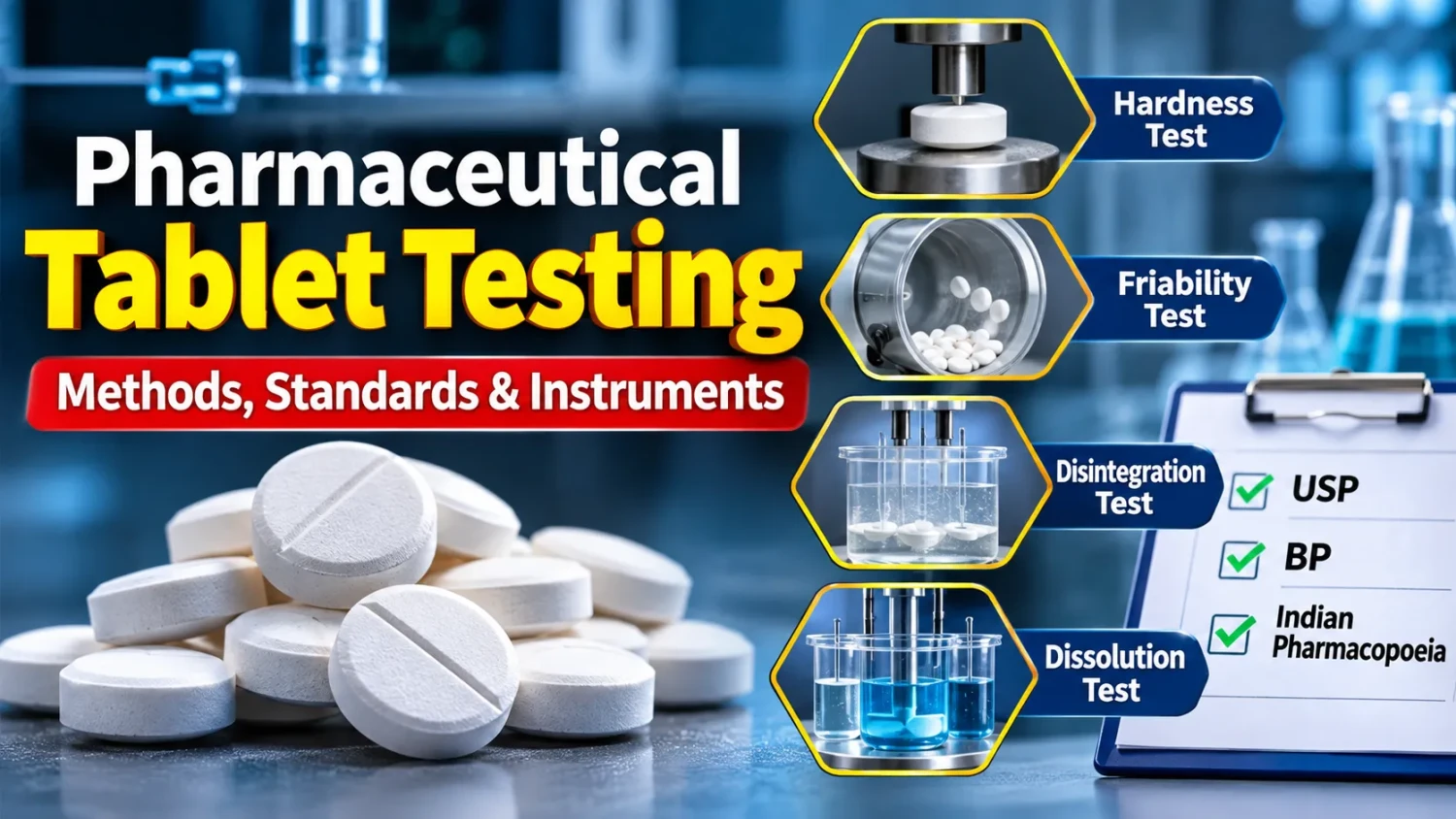
Pharmaceutical tablets are among the most common solid dosage forms, so quality control matters at every stage. You need to know that a tablet is strong enough for handling, yet able to break down and release its active ingredient as intended. That is why pharmaceutical tablets go through defined tests during development, manufacturing, and finished product checks. These methods help confirm consistency, support compliance, and reduce the chance of poor performance from one batch to the next.
Key Highlights
Tablet quality control uses hardness, friability, disintegration, and dissolution checks to confirm performance.
These tests help show whether a tablet can withstand handling, packaging, and transport.
Hardness and friability measure physical strength and resistance to abrasion during routine movement.
Disintegration and dissolution assess how tablets break down and release the active ingredient.
Pharmacopoeia standards such as USP, BP, and Indian Pharmacopoeia define methods and limits.
Proper testing supports batch uniformity, compliance, and dependable quality in solid dosage forms.
Key Methods in Pharmaceutical Tablet Testing
When you ask what the main methods are for quality control testing of a tablet, four stand out in routine practice: hardness, friability, disintegration, and dissolution. These are widely used to confirm physical integrity and performance during manufacturing and release.
At the same time, official tests in a pharmacopoeia also cover content of active ingredient, uniformity of weight, and content uniformity for a batch. Together, these checks help show whether tablets meet set limits and behave as intended. The next sections explain the standard procedures behind these methods.
Overview of Standard Testing Procedures
Official tests for tablet quality are described in recognized compendia. These standards are followed so manufacturers and laboratories use the same procedures, limits, and acceptance criteria. In routine practice, USP, BP, and Indian Pharmacopoeia are the main references named for these checks.
These compendia cover tests linked to drug content and in vitro release. They include content of active ingredient, uniformity of weight, content uniformity, disintegration time, and dissolution. They also describe equipment requirements and test conditions for hardness, friability, disintegration, and dissolution used in quality control labs.
You can think of these standards as a common rulebook. They help ensure a tablet batch is checked in a repeatable way instead of by guesswork. That consistency matters because a result has value only when the method, apparatus, and limit are clearly defined under USP, BP, or Indian Pharmacopoeia requirements.
Importance of Adhering to Testing Standards
Pharmacopoeial tests on tablets exist to confirm that products meet defined specifications for quality and performance. If you follow set methods, you can judge whether tablets are acceptable, uniform, and suitable for release. This is also closely tied to GMP expectations during manufacturing and in-process checks.
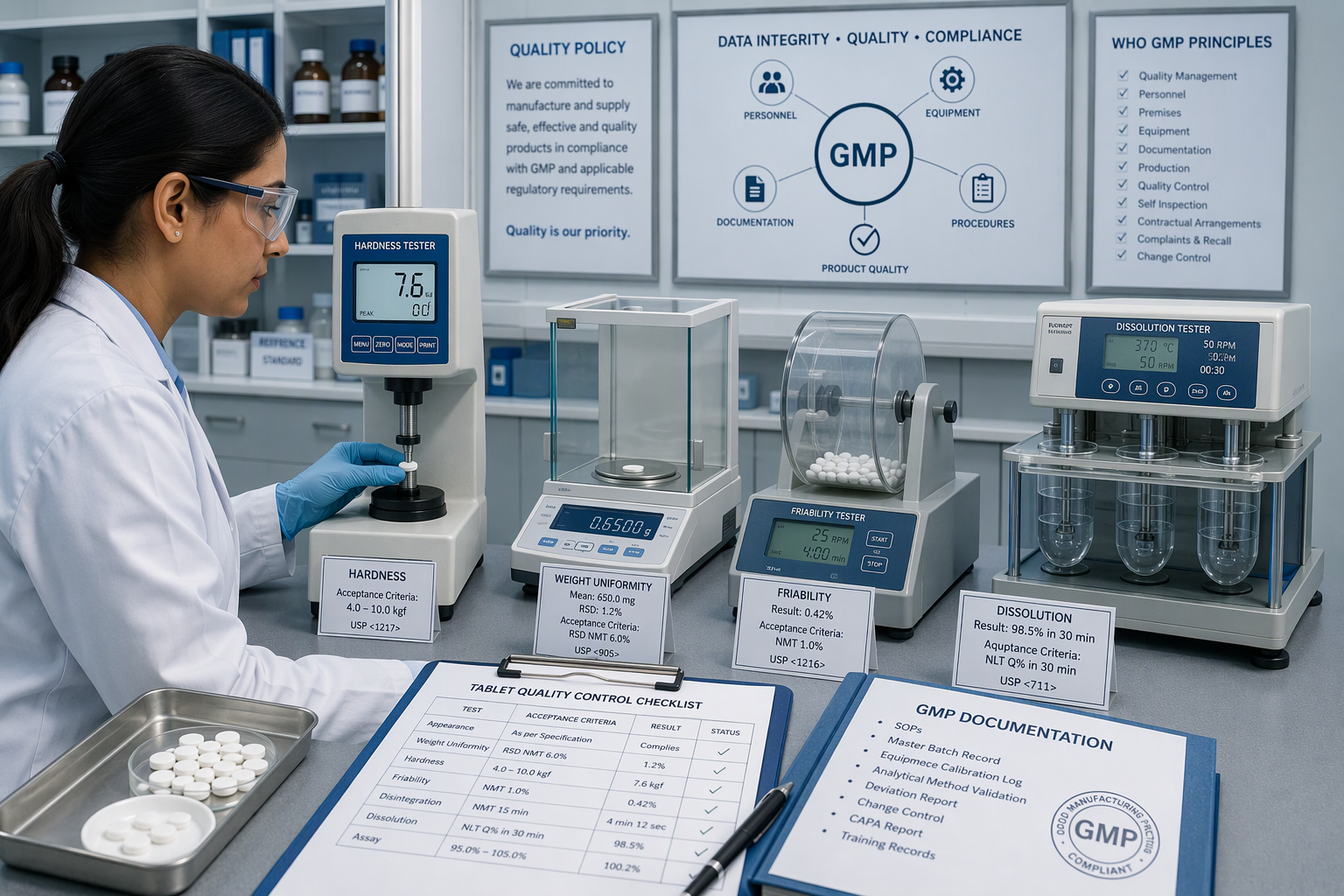
For example, hardness is tested in-process at defined intervals and again on finished samples to maintain consistency through the compression run. Laboratories also rely on calibrated instruments, often with NABL traceable calibration, so the readings remain dependable and precise.
They verify tablets meet official specifications and acceptance limits.
They support GMP systems and consistent batch control.
They improve confidence in quality before release or distribution.
They align testing with recognized regulatory expectations, including FDA-focused quality systems.
When standards are ignored, results become harder to trust. A tablet may look fine, but without proper testing against established requirements, you cannot confirm whether it will perform correctly in real use.
Tablet Hardness Testing
Hardness testing tells you how much force is needed to crush a tablet. In simple terms, it checks whether the tablet has enough mechanical strength to survive routine handling, packaging, and transport without breaking too easily.
The result is closely linked to compression force during manufacturing. If hardness is too low, tablets may become brittle or friable. If it is too high, they may disintegrate too slowly. Because of that balance, hardness testing is a basic part of tablet quality control and in-process monitoring.
Measuring Hardness and Crushing Strength
Tablet hardness is measured as the force required to crush a tablet across its diameter. This value is often called crushing strength. The reading is usually expressed in Newtons or kiloponds, giving a direct measure of tablet hardness under controlled conditions.
In practice, a sample of tablets is tested with a motorized instrument that applies force at a constant rate. Many systems can report minimum, maximum, mean, and standard deviation across a set of 10 tablets. That helps you see not only the average result but also the spread within the sample.
Why does this matter so much? Mechanical strength must be high enough to protect tablets during routine movement, yet not so high that excessive hardness slows breakdown. A tablet with poor hardness may chip or fail in handling, while one with excessive hardness may resist disintegration longer than intended.
Instruments Used in Hardness Evaluation
The main apparatus for hardness evaluation is a motorized tablet hardness tester, also called a crushing strength tester. This equipment is designed to apply force in a controlled way and show the result on a digital display. For reliable work, precision in loading and measurement is essential.
A typical system includes a load cell, motorized jaw drive, and digital readout. Many units are calibrated against certified reference masses with NABL traceable records. That matters because a hardness result is useful only when the instrument itself is dependable.
This kind of equipment is common in pharmaceutical labs because it supports repeatable hardness testing across routine batch checks.
Friability Testing for Tablets
Friability testing checks how well tablets resist surface wear and small breakage during normal handling. Instead of measuring crushing force, it looks at damage caused by tumbling and abrasion, which can happen during manufacturing, transport, and packaging.
This test is useful because a tablet may have acceptable hardness but still lose particles too easily. By measuring weight loss after controlled rotation in a drum, you can see whether the sample can hold up under routine stress. Next, let’s look at how the friability test is carried out.
Performing the Friability Test Effectively
A friability test measures the percentage weight loss of tablets after they tumble in a rotating drum. This simulates abrasion and impact during regular movement. Under standard conditions, tablets are first de-dusted, then weighed carefully before the run begins.
The sample is placed in a transparent drum with an internal baffle. The drum runs at 25 RPM for 4 minutes, giving 100 rotations in total. After that, tablets are removed, de-dusted again, and weighed. Friability is calculated from the difference between initial and final weight.
Why is this effective? The method gives a simple way to check whether tablets can tolerate routine stress under GMP-controlled production. Standard limits are important here. IP and USP generally set friability at not more than 1.0%, unless a specific monograph states otherwise.
Recognizing Common Issues Detected
Tablet quality control tests often reveal physical problems before products reach the market. These issues may appear during hardness, friability, disintegration, or related checks. Looking closely at a batch can help you spot whether tablets are too weak, too hard, or physically unstable.
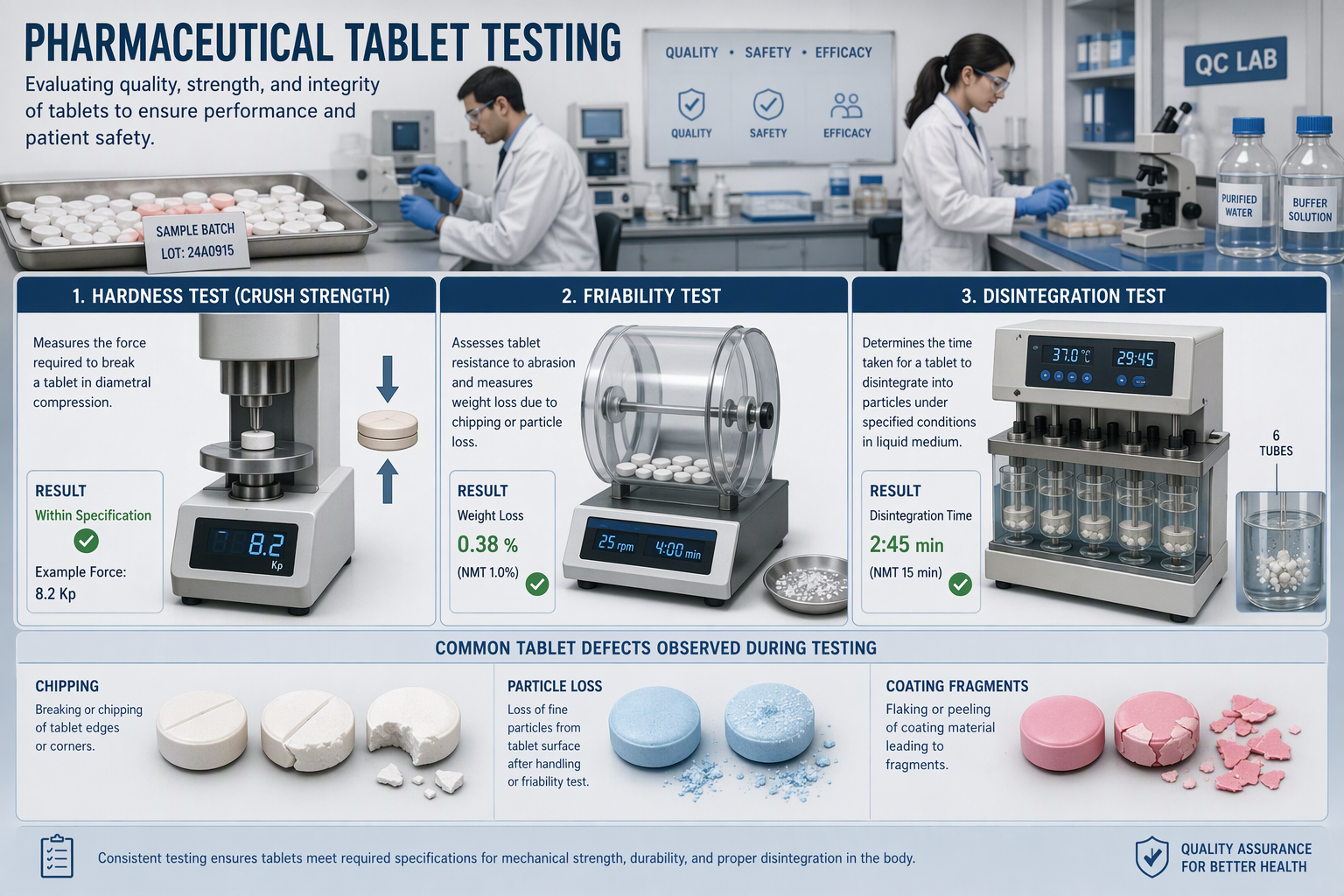
Some problems are easy to see after testing, while others show up through unusual readings or poor performance against set limits. Even small defects matter because they can affect handling, packaging, and in vitro behavior.
Chipping at tablet edges after tumbling or routine handling
Breakdown or excessive particle loss during friability testing
Coating fragments remaining after testing, even when the core changes
Wide variation across a batch, suggesting inconsistent compression or manufacture
When these signs appear, they point to a need for closer review of the batch. Physical defects can reduce appearance, strength, and consistency, which is why routine testing remains so important.
Disintegration and Dissolution Tests
Disintegration and dissolution tests focus on how tablets behave once they meet liquid. For solid dosage forms, that is a key part of performance. A tablet must first break apart, then release the active ingredient into solution at the expected rate.
These two tests are related, but they are not the same. Disintegration shows physical breakup, while dissolution measures drug release into the medium. If you want a clearer picture of tablet behavior, you need to understand both. The next sections explain their roles and standards.
Role of Disintegration in Tablet Quality
Disintegration testing involves measuring how long a tablet takes to break down into smaller particles under standardized conditions. For many dosage forms, this is the first step toward drug release. A tablet is placed in a tube assembly and moved up and down in a liquid medium.
The standard apparatus uses a six-tube basket-rack with mesh at the bottom. During the test, the basket moves at 29 to 32 cycles per minute in water or another stated medium, usually kept at 37°C ± 0.5°C. The goal is to check whether the tablet breaks apart within the required time.
Pharmacopoeia limits vary by product type. Uncoated tablets commonly have a 15-minute limit, while film-coated tablets may allow 30 minutes. Enteric-coated products follow different conditions. This test is important because disintegration shows physical breakdown, even though it does not by itself guarantee full drug release.
Significance and Standards of Dissolution Testing
Dissolution testing measures the rate and extent of drug release from a tablet into a liquid medium. In simple terms, it shows how much of the amount of active ingredient goes into solution over time. That makes it more informative than disintegration when you want to judge release behavior.
This matters because a tablet can break apart quickly but still release drug slowly. That gap is especially important for products where in vitro release better reflects expected performance. For immediate-release products, Paddle apparatus is commonly used, while Basket apparatus is preferred for floating forms and capsules.
USP, BP, and Indian Pharmacopoeia define the main standards used for dissolution testing. They describe vessel setup, temperature control, speed range, and equipment requirements. With those standards in place, you can compare results against accepted limits and confirm whether a tablet meets the expected release profile.
Conclusion
In summary, understanding the methods and standards involved in pharmaceutical tablet testing is crucial for ensuring product quality and efficacy. By adhering to established testing procedures, manufacturers can maintain tablet hardness, friability, and disintegration characteristics, all of which significantly impact patient safety and treatment outcomes. Leveraging the right instruments and following industry standards not only fulfills regulatory requirements but also fosters trust with consumers and healthcare professionals alike. In a field where precision is paramount, making informed choices about testing practices can lead to higher-quality products that meet the needs of patients effectively. If you’re looking to enhance your knowledge further or need expert guidance, feel free to reach out for a consultation!
Frequently Asked Questions
What are the most common methods used in pharmaceutical tablet testing?
The most common tablet tests include hardness, friability, disintegration, and dissolution. Routine quality control may also include content uniformity and uniformity of weight. Friability focuses on weight loss after tumbling, while hardness and dissolution help confirm that tablets are strong enough and release drug as expected.
How do industry standards influence the testing of pharmaceutical tablets?
Industry standards shape tablet testing by defining official tests, test conditions, equipment needs, and acceptance specifications. USP and BP provide recognized methods, while GMP systems ensure they are followed consistently in manufacturing and quality control. This helps laboratories assess tablets using repeatable and accepted procedures.
What instruments are typically employed in the analysis and testing of pharmaceutical tablets?
Common apparatus used for tablet testing includes a hardness tester, friabilator, disintegration tester, and dissolution tester. These instruments measure crushing strength, resistance to abrasion, tablet breakup time, and drug release in liquid media. Some dissolution systems are also paired with UV/Vis equipment for assay work.
How can manufacturers ensure compliance with regulatory requirements during tablet testing?
Manufacturers can support compliance by following good manufacturing practices, using recognized standards such as USP, BP, or IP, and testing each batch at defined stages. Calibrated instruments with NABL traceable records also improve confidence in quality, helping results stay accurate, consistent, and ready for review.
Recent Posts
Understanding Pharmaceuticals Tablet Testing: Methods, Standards, and Instruments

Understanding Process Control Instruments and Their Role in Industrial Efficiency

How Petroleum Testing Instruments Improve Fuel Quality and Compliance Standards?

Analytical & Elemental Instruments: Empowering Accurate Analysis for Research, Quality Control, and Industrial Applications


How Viscosity, Rheometer & Texture Analyzer Shape Product Quality in R&D Laboratories?

How Laboratory Heating & Cooling Equipment Improves Accuracy and Efficiency in Testing?

The Role of Laboratory Safety & Environmental Monitoring in Risk Prevention
Optimum Solution– Laboratory & Analytical Instruments Supplier in Bangladesh
Optimum Solution is a leading supplier of laboratory equipment, analytical instruments, and process control solutions in Bangladesh. Since our inception, we have built a strong presence in the industry, serving research labs, universities, pharmaceutical companies, and quality control laboratories nationwide. Through continuous dedication to improving our products and services, Optimum Solution has earned the trust and loyalty of our valued clients.


