

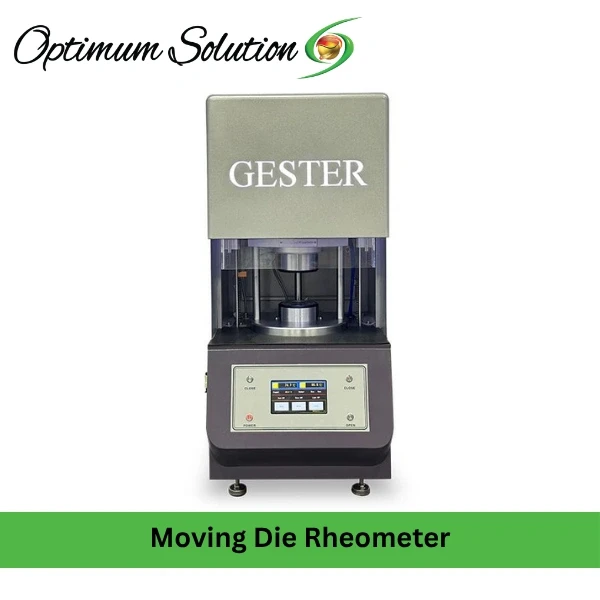
Moving Die Rheometer: Rubber Cure Test – 200°C, 200 lb-in Torque
Inhouse product
-
 ৳19,995.00
৳20,000.00 -
৳12,995.00
৳13,000.00 -
৳979,995.00
৳980,000.00 -
৳649,995.00
৳650,000.00 -
৳19,495.00
৳19,500.00 -
৳2,999,995.00
৳3,000,000.00


Reviews & Ratings
A rubber compound's curing behavior determines whether a batch becomes a usable part or scrap. The Moving Die Rheometer measures that behavior directly: a sealed specimen is heated under pressure while the lower die oscillates sinusoidally, and a torque sensor on the upper die records the compound's response. The resulting cure curve reveals scorch time, optimum cure time, cure rate, and reversion characteristics. This Moving Die Rheometer is built for rubber compounders, tire and seal manufacturers, and materials research laboratories that need ISO 6502 and ASTM D5289 data from a rotorless, sealed-die platform.
Technical Specifications
The Moving Die Rheometer is supplied as a single model, GT-KR02, with the sealed die assembly, servo motor drive, PID temperature control, and RS232 communication configured as a complete benchtop test station.
GT-KR02 Core Configuration
Model/Part Number: GT-KR02
Applicable Standards: ISO 6502-3-2018, ASTM D5289-2017, GB/T 16584-1996
Die Configuration: Sealed die
Temperature Control: Computer operation, PID.SSR control
Temperature Range: RT+10°C to 200°C
Temperature Display Resolution: 0.1°C
Temperature Accuracy: ±0.3°C
Temperature Recovery Time: ≤45 seconds
Heating Time: Ambient to 190°C in under 6 minutes
Torque Range: Elasticity S': 1 to 200 lb-in
Torque Resolution: 0.01
Torque Units: dN-m, kgf-cm, lbf-in
Oscillation Amplitude: ±0.5°, ±1°, ±2°, ±3° (select one, default ±0.5°)
Oscillation Frequency: 100 CPM (1.67 Hz ± 0.01 Hz)
Testing Time: 0.1 seconds to 99 hours
Motor: Servo Motor
Communication Interface: RS232
Compressed Air Requirement: 4 kg/cm² (0.4 MPa), customer-supplied
Power Supply: 1-phase AC 220V, 50/60Hz, 800W
Weight: Approximately 200 kg
Standard Accessories Included
Moving Die Rheometer main unit
Sealed die assembly
Servo motor drive system
PID/SSR temperature controller
RS232 communication cable
Operation software
Operation manual
Items Excluded
Compressed air supply (customer-prepared, 0.4 MPa)
Calibration certificate (available upon request)
Extended warranty (available for purchase)
On-site installation and commissioning (available as a service)
Test compounds (prepared by the user)
Pre-installation Requirements
Stable, level floor or bench with load-bearing capacity for the approximately 200 kg unit
Dedicated 1-phase AC 220V, 50/60Hz power supply
Compressed air supply at 4 kg/cm² (0.4 MPa) with appropriate regulator and hose
Computer with RS232 port for software operation and data logging
Ambient laboratory conditions free from strong vibration and temperature fluctuation
Operator training on rheometer operation and rubber compound handling is recommended
Key Benefits: Reliable Cure Curves Without Rotor Interference
Rotorless Sealed Die Design Eliminates Rotor Mass Effects
The Moving Die Rheometer uses a sealed die with no rotor. In rotor-based rheometers, the rotor's thermal mass and mechanical drag influence the torque reading. The GT-KR02 oscillates the lower die directly, and the upper die sensor measures only the specimen's response. The cure curve reflects the compound, not the instrument's moving parts.
Temperature Accuracy of ±0.3°C for Reproducible Cure Kinetics
Cure reactions are temperature-sensitive. A drift of a few tenths of a degree shifts scorch time and optimum cure time. The GT-KR02 holds ±0.3°C accuracy with 0.1°C display resolution, and recovers to setpoint within 45 seconds after die opening. Each test starts from the same thermal condition.
Fast Heating for High-Throughput Testing
The chamber heats from ambient to 190°C in under 6 minutes. For labs running multiple compounds per shift, the reduced heat-up time means more tests per day without waiting for the die to stabilize between runs.
Servo Motor Drive for Consistent Oscillation
The oscillation frequency holds 100 CPM (1.67 Hz ± 0.01 Hz) under servo motor control. Amplitude is selectable at ±0.5°, ±1°, ±2°, or ±3°. The drive maintains the selected strain throughout the test, so the torque response reflects the compound's viscoelastic behavior rather than motor variation.
To explore how this Moving Die Rheometer fits into your rubber testing workflow, visit our website at Optimum Solution to compare related rubber cure and viscoelastic testing instruments. For detailed product specifications and application notes, you can view the GESTER moving die rheometer product page on the manufacturer's site. For information on rubber cure testing standards, refer to the ISO 6502 standard or the ASTM D5289 specification.
Solving the Problems That Slow Rubber Compound Qualification Down
Struggling to get reproducible cure curves between batches?
The sealed die and ±0.3°C temperature accuracy remove two common sources of variation. The servo-driven oscillation holds frequency and amplitude, so the torque signal reflects the compound rather than the instrument.
Concerned that rotor-based rheometers introduce measurement artifacts?
The rotorless design eliminates rotor mass and drag from the torque reading. The upper die sensor measures only the specimen's response to the lower die oscillation.
Tired of waiting for the die to heat up between tests?
The chamber reaches 190°C from ambient in under 6 minutes, and recovers to setpoint within 45 seconds after opening. Compound changeovers take less time, and throughput improves.
Need cure data that maps to ISO 6502 or ASTM D5289 review?
Temperature accuracy, oscillation frequency, and torque range follow the standard requirements. The RS232 interface exports test data for records, and the cure curve parameters are calculated from the measured torque.
Warranty and Support
We provide a 1-year manufacturer's warranty covering parts and labor. Technical support, installation assistance, and operational training are also available. Replacement parts and consumables are available throughout the product's service life.
Call to Action
Request a Quotation or Technical Datasheet: Contact us for more information, customized configurations, and solutions tailored to your specific requirements.
Frequently Bought Products
-
৳19,995.00
৳20,000.00 -
৳12,995.00
৳13,000.00 -
৳979,995.00
৳980,000.00 -
৳649,995.00
৳650,000.00 -
৳19,495.00
৳19,500.00 -
৳2,999,995.00
৳3,000,000.00
Optimum Solution– Laboratory & Analytical Instruments Supplier in Bangladesh
Optimum Solution is a leading supplier of laboratory equipment, analytical instruments, and process control solutions in Bangladesh. Since our inception, we have built a strong presence in the industry, serving research labs, universities, pharmaceutical companies, and quality control laboratories nationwide. Through continuous dedication to improving our products and services, Optimum Solution has earned the trust and loyalty of our valued clients.


