
-
 Analytical & Elemental Instruments
-
Biotechnology Lab Items
-
Cardboard and Box Factory Lab Equipment Solution
-
Cleanroom Solution
-
Climatic Aging Chamber
-
Consumables & Accessories
-
Dosing Pump for Chemicals
-
Electrochemistry & Titration
-
Electronics
-
ETP -Effluent Treatment Plant
-
Feed Quality Laboratory
-
Food & Kitchen Lab Items


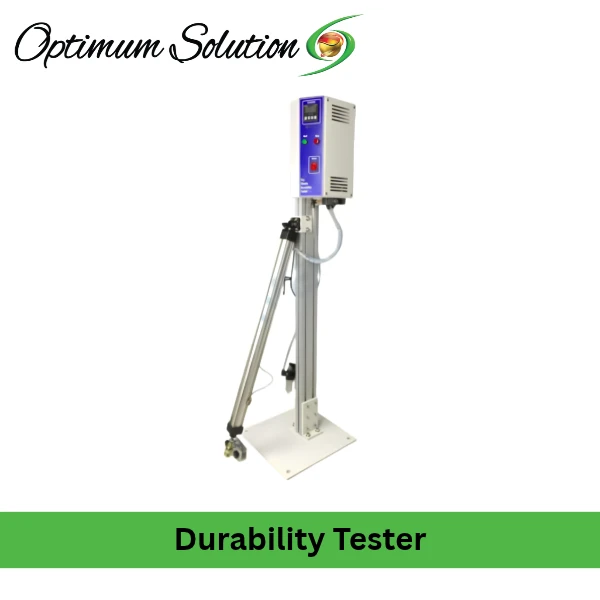
Toy Chest Lids Durability Tester AT14: Toy Safety Testing Equipment – 7000 Cycles and 0°–80° Swing Angle
Inhouse product
-
৳19,995.00
৳20,000.00 -
৳12,995.00
৳13,000.00 -
৳979,995.00
৳980,000.00 -
৳649,995.00
৳650,000.00 -
৳19,495.00
৳19,500.00 -
৳2,999,995.00
৳3,000,000.00



Reviews & Ratings
Technical Specifications
The AT14 is a toy chest lid durability tester from AVENO, built to verify that hinged toy box lids survive repeated opening and closing without hinge failure. A telescopic rod driven by a pneumatic swing lever moves the lid through a 0°–80° arc at 15 seconds per cycle, and the counter tracks cycles up to 9,999. The test runs to the standard cycle count of 7,000 before the hinge function is inspected. The instrument accepts samples up to 700 mm in height and references EN 71-1, ASTM F963, ISO 8124-1, 16 CFR 1500, and GB 6675-2. The specifications below cover the standard unit.
Model/Part Number: AT14
Test Performance
Test principle: telescopic rod moves the toy box lid through repeated open/close cycles
Test speed: 15 seconds per cycle
Swing lever rotation angle: 0°–80°
Standard test cycles: 7,000
Counter: LED display, 0–9,999 cycles, settable
Maximum sample height: 700 mm
Drive: pneumatic, via air source
Air and Power Requirements
Air source: 6 kgf/cm² stable air pressure
Power supply: 220 V, 50/60 Hz
Physical Specifications
Dimensions (W x D x H): 115 x 35 x 126 cm
Weight: 30 kg
Brand: AVENO
Origin: China
Standards Referenced
EN 71-1 section 8.31.1
ASTM F963 section 5.1
ISO 8124-1 section 5.13.2.2
GB 6675-2 section 5.13.2.2
16 CFR 1500
Certification
CE
ISO 9001
ISO 17025
Standard Accessories Included:
AT14 toy chest lids durability tester base unit
Rubber tube for air connection, 1 pc
Power line, 1 pc
Operating manual
Items Excluded:
Air compressor or compressed air supply capable of 6 kgf/cm²
Test samples
Calibration services
Additional fixture adaptors for non-standard lid geometries
Pre-installation Requirement:
Place the tester on a rigid, level floor or bench capable of supporting 30 kg plus the sample, with clearance for the 0°–80° swing arc and access to the sample mounting area. Connect the air tube to a stable compressed air supply at 6 kgf/cm². Connect the power line to a grounded 220 V, 50/60 Hz supply. Confirm the counter and swing lever move freely through the full arc before mounting the first sample.
Why This Tester Belongs in a Toy Safety Lab
Toy chest lid failures do not show up in a visual inspection. A hinge that holds on the first open and fails on the four-thousandth is exactly what the durability test exists to find, and exactly what a manual check cannot reproduce. The AT14 toy chest lids durability tester runs the repeated open/close cycle the standards require, at a fixed 15 seconds per cycle, and stops at the 7,000-cycle count the test specifies.
The pneumatic drive is what makes the repeated motion consistent. Each cycle moves through the same 0°–80° arc at the same speed, so the hinge sees the same load profile every time. If the hinge begins to bind or the lid alignment shifts, that shows up in the cycle data rather than in an operator's judgment about whether the motion felt the same as last time.
The sample envelope of 700 mm in height covers standard toy chest sizes, and the 115 x 35 x 126 cm footprint fits a dedicated safety testing bench without dominating the room. For labs running multiple product lines, the settable counter allows shorter screening runs before the full 7,000-cycle validation.
For buyers sourcing through OS4U, the configuration questions are the air supply setup, whether fixture adaptors are needed for non-standard lid geometries, and whether the tester sits alongside other toy safety equipment such as the small parts cylinder or sharp edge tester. The AVENO AT14 product page lists the current accessory range.
Key Benefits
Repeated cycles without operator variation
The AT14 toy chest lids durability tester moves the lid through the same 0°–80° arc at the same speed on every cycle. The load profile does not depend on how firmly an operator pulls or how quickly they release.
Standards coverage that matches the test method
The instrument references EN 71-1 section 8.31.1, ASTM F963 section 5.1, ISO 8124-1 section 5.13.2.2, and GB 6675-2 section 5.13.2.2. The 7,000-cycle count and the swing geometry align with the method rather than approximating it.
Counter that tracks the full run
The LED counter displays cycles from 0 to 9,999 and is settable. For a full validation run, it tracks the 7,000 cycles without manual tallying. For shorter screening runs, the count is set lower and the run stops at that point.
Pneumatic drive for consistent force
The telescopic rod is driven by a pneumatic swing lever at 6 kgf/cm² stable air pressure. Compressed air delivers consistent force across the run, which is what makes cycle-to-cycle variation small enough for the test to be meaningful.
Sample size that covers standard toy chests
The 700 mm maximum sample height accepts standard toy chest lids. The 115 x 35 x 126 cm footprint fits a safety testing bench, and the 30 kg weight allows relocation if the lab layout changes.
Records that support the certificate
The counter display and the standards coverage give the lab the data needed to document a test against EN 71-1, ASTM F963, or ISO 8124-1. Certification against CE, ISO 9001, and ISO 17025 supports the tester's own traceability.
Solving the Problems That Slow Durability Testing Down
Getting inconsistent results between runs? The pneumatic drive moves the lid through the same arc at the same speed on every cycle. Cycle-to-cycle variation comes from the air supply, not from the operator.
Losing count during a 7,000-cycle run? The LED counter tracks cycles up to 9,999 and is settable. The run stops at the set count rather than requiring manual tallying.
Testing non-standard lid geometries? The 0°–80° swing and 700 mm height accept standard toy chest lids. Fixture adaptors can be added for non-standard geometries.
Worried about matching the standard exactly? The instrument references EN 71-1, ASTM F963, ISO 8124-1, and GB 6675-2 at the specific section numbers, with the 7,000-cycle count and swing geometry the method specifies.
Needing to screen samples quickly before full validation? The counter is settable, so shorter runs can screen a batch before the full 7,000-cycle validation runs on the samples that pass.
Worried about compressed air availability? The air requirement is 6 kgf/cm² at a stable pressure, which most lab compressed air supplies can provide. A regulator and filter at the tester inlet keep the pressure stable across the run.
Warranty & Support
We provide a 1-year manufacturer’s warranty covering parts and labor. Technical support, installation assistance, and operational training are also available. Replacement parts and consumables are available throughout the product’s service life.
Request a Quotation or Technical Datasheet
Contact us for more information, customized configurations, and solutions tailored to your specific requirements.
Frequently Bought Products
-
৳19,995.00
৳20,000.00 -
৳12,995.00
৳13,000.00 -
৳979,995.00
৳980,000.00 -
৳649,995.00
৳650,000.00 -
৳19,495.00
৳19,500.00 -
৳2,999,995.00
৳3,000,000.00
Optimum Solution– Laboratory & Analytical Instruments Supplier in Bangladesh
Optimum Solution is a leading supplier of laboratory equipment, analytical instruments, and process control solutions in Bangladesh. Since our inception, we have built a strong presence in the industry, serving research labs, universities, pharmaceutical companies, and quality control laboratories nationwide. Through continuous dedication to improving our products and services, Optimum Solution has earned the trust and loyalty of our valued clients.


